IA en un minutoNewsBusiness and products
Big tech companies will contribute $2.4 billion to the Genesis Mission, the US plan for AI-driven research
IA en un minuto newsroom · Editor: Jon Elgezabal
In 30 seconds
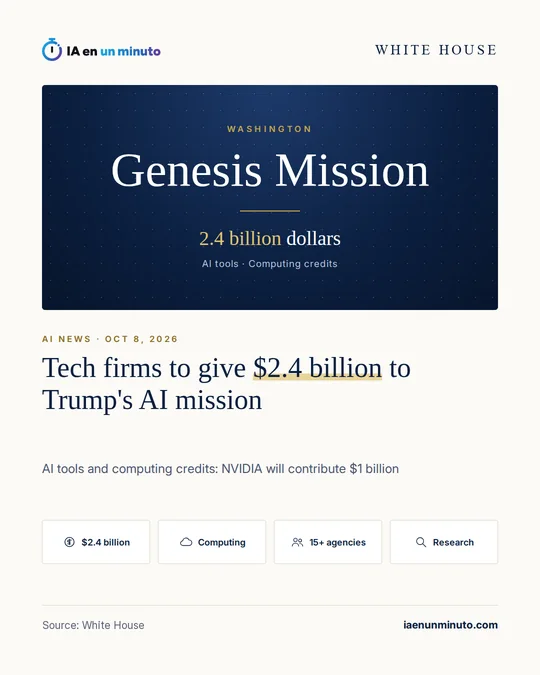
The White House has lined up eleven tech companies that will put $2.4 billion in computing and AI tools at the service of US public science. NVIDIA leads the list with $1 billion, followed by AMD, OpenAI, Anthropic and Google. Bloomberg notes it is still unclear how researchers will be guaranteed that computing time, and the government is adding a $100 million fellowship for fast-track PhDs.
The White House has announced pledges worth $2.4 billion from eleven tech companies to boost scientific research with artificial intelligence.
The Trump administration presented them this Thursday at a science summit in Washington. They are AI tools for science (the White House calls it superintelligence) and computing credits for the Genesis Mission Consortium, the US government plan to do research with AI, and will support more than 15 federal agencies. NVIDIA will contribute $1 billion, AMD $500 million, OpenAI $200 million, and Anthropic and Google $150 million each. AMP and Emerald AI are contributing $100 million each, and AWS, Armada, Crusoe, and Micron $50 million each.
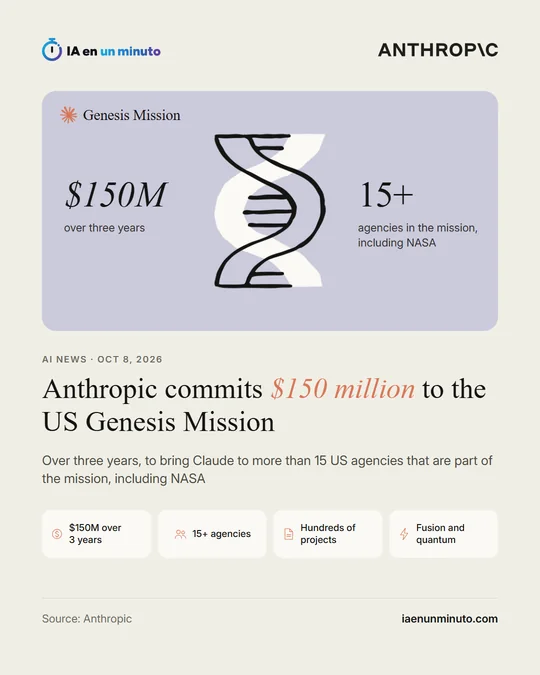
According to the White House, the pledges follow the expansion of the mission in July to more than 15 federal agencies and a $5 billion federal commitment to national science and technology challenges across energy, health, space, and other fields. According to Politico, in an article carried by Yahoo that cites statements from the administration and the companies, NVIDIA's share is computing capacity over the next five years; OpenAI's, token discounts and training programs for scientists; Anthropic's, access to Claude over three years; and AWS's, cloud credits.
At the same summit, the government launched the Genesis Mission Fellowship, a $100 million program for students to pursue accelerated four-year PhDs with dual competency in superintelligence and another science or engineering discipline, with research experience embedded in industry and at a Department of Energy national laboratory.
According to Bloomberg, it is not clear how that computing capacity will be set aside for scientists, at a time when the big cloud providers already face high demand and lucrative prices for computing power.
Why it matters · analysis and opinion
That the same chipmakers and AI labs competing to sell computing are contributing it to public science says a lot about how power in research is being shared today: whoever controls the data centers sets the pace. For the companies, it is also a way to place their models and chips inside federal agencies and to train scientists on their tools. What is missing for it to have a real effect is the how, which part arrives as guaranteed capacity and which part as discounts or credits that depend on free room in data centers already in high demand. And it confirms that the race for scientific AI is increasingly played out through deals between the government and big tech, not only with public budgets.
Official source: White House · Written with the help of AI: how we make the news