Anthropic bans sustained abuse of Claude and deceiving voters in its new usage policy
IA en un minuto newsroom · Editor: Jon Elgezabal
In 30 seconds
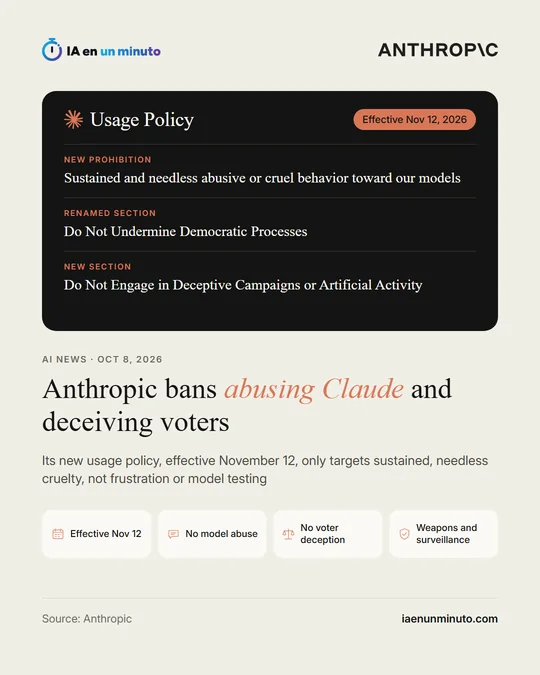
Anthropic is refreshing the rules that limit what Claude may be used for, with the changes kicking in on November 12. The company now bars tormenting the model over and over for no reason, while ordinary complaints and experiments stay allowed. In politics, the ban now centers on manipulating voters or interfering with elections, and legitimate tailored outreach is no longer off-limits.
Anthropic has published a new version of its usage policy, the rules that set out what Claude cannot be used for. It updates the policy every year, and this version takes effect on November 12. According to the policy text, it applies to all of its users, from people using its apps, such as Claude.ai or Claude Code (its coding tool), to developers and businesses that work with its API. The company says most of the changes are meant to clarify existing rules, with examples of how they apply now that Claude takes on longer, more independent work, and based on the misuse it has seen over the past year in influence operations, weapons development and surveillance.
Among the changes is a ban on sustained and needless abusive or cruel behavior toward its models. According to Anthropic, it will only apply in extreme cases, when someone repeatedly acts cruelly toward its models with no discernible purpose, and it does not cover common versions of user frustration, pushing back on the model, dark creative themes or model testing and research. The main way to enforce it will remain Claude's ability to end those conversations, which it can already do, in rare cases, with persistently abusive users on Claude.ai and Claude Code.
The elections section has been renamed "Do Not Undermine Democratic Processes" and now focuses on stopping Claude from being used to deceive voters or disrupt elections, for example by spreading false information about candidates or how to vote, impersonating candidates or election officials, or trying to suppress turnout. At the same time, Anthropic is removing its blanket ban on personalized vote and campaign targeting, because it also covered legitimate uses, such as nonprofits writing information for voters in other languages or election officials sending ballot cure notices. Targeting voters through deception or the misuse of their personal data remains prohibited, now under the deceptive campaigns, surveillance and privacy sections.
It also brings together, in a new section titled "Do Not Engage in Deceptive Campaigns or Artificial Activity", the rules against deceptive campaigns, whether political or commercial, which used to be scattered across the elections, fraud, privacy and disinformation sections. It covers hiding who is behind a message, amplifying content through fake accounts or posts, and building the tools and infrastructure for influence operations. Anthropic says it has seen state media outlets, government propaganda offices and commercial firms use Claude to run networks of fake accounts and fabricated news sites, something its policy already prohibited.
The policy also makes clear that Claude cannot be used for the software and components that make weapons work or to arm drones and other autonomous vehicles. Anthropic says it has seen attempts to use its models to build guidance and control software for weapons, and that the change reflects how it already enforced the previous rule. In surveillance, it prohibits tracking people without their consent, whether in real time or by analyzing previously collected data, building or improving tools designed for surveillance, and using Claude to decide or recommend who to investigate, arrest or charge in a law enforcement or criminal justice process. According to the company, this does not change what it enforces in practice either, and tracking that people have agreed to (such as fraud monitoring), content moderation, journalism and legal research remain permitted.
The requirements for high-risk uses, those that can affect someone's health, legal rights, finances, livelihood or access to essential services, have not changed: a qualified person who can review and, if necessary, change Claude's recommendations, and telling the person affected that AI was used. The section has been rewritten to say which recommendations are covered and which are not, and it adds requirements for when its models are connected to hardware that takes physical actions on its own and could cause injury: a qualified operator must be able to watch it and stop it if needed, and the equipment must be able to hold a safe state if Claude is disconnected.
Anthropic has also clarified on its supported regions page how it enforces the restriction it introduced last year: Claude cannot be used by people physically located in an unsupported region, by entities incorporated or headquartered in one, or by entities majority-owned or controlled by people or entities in those regions.
Why it matters · analysis and opinion
The rule that will grab the most headlines, the one on abusing the model, barely changes day-to-day use: Claude could already end those conversations, and the company itself limits it to extreme cases. What touches more people is the election part and the surveillance part. A nonprofit or an election authority that wants to write to voters in other languages gains room, while anyone who tracks people or supports police decisions now has the line drawn in more detail. For anyone connecting Claude to machines, the operator able to stop them and the safe state without a connection mean reviewing the design before the policy takes effect. And since the policy also reaches people who use third-party products built on Claude, the companies offering them have reason to go over their own terms of use.
Official source: Anthropic · Written with the help of AI: how we make the news