Sierra and Meta back an open protocol so personal AI agents can authenticate with businesses
IA en un minuto newsroom · Editor: Jon Elgezabal
In 30 seconds
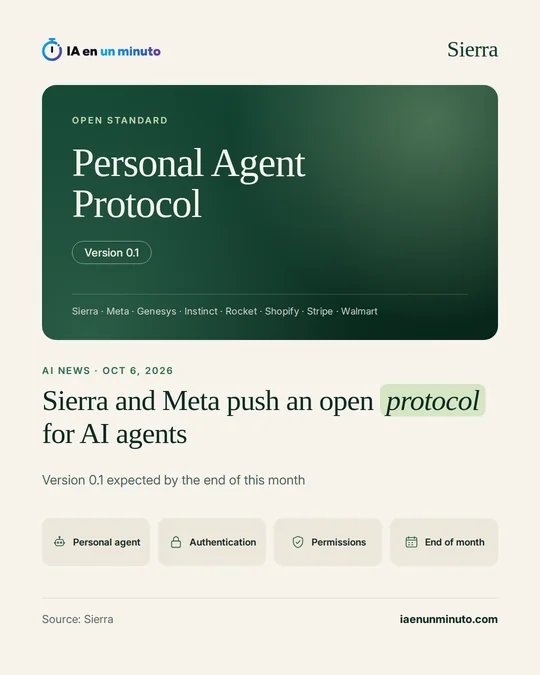
Sierra and Meta are drafting Personal Agent Protocol, an open rulebook for how personal AI agents present themselves and operate when dealing with companies. Shopify, Stripe and Walmart are among the partners, and Sierra expects version 0.1 to arrive this month. Sierra describes agents starting out as guests and relying on OAuth for account access, with the customer choosing read or change permissions.
AI agents that run errands for their users could soon have a common set of rules.
Sierra and Meta are developing Personal Agent Protocol, an open standard that sets out how personal AI agents deal with businesses: how they identify themselves and how they act on company websites, through company APIs or with a company's own agents. Shopify, Stripe and Walmart are also taking part, as are Genesys, Instinct and Rocket, and anyone will be able to implement it. Sierra plans to publish the first specification, version 0.1, later this month, to hold design workshops and to release a reference implementation for developers.
Sierra's starting point is that most of these agents currently use websites and apps as a person would: they load pages and fill in forms and, when that is not enough, they phone the support line or open the company's chat. That can take a long time and end with the task undone, whereas a direct connection would settle it securely in seconds.
With the protocol, the agent finds out on the company's website what it offers and how to connect, and opens a session for its user. It can begin as a guest, and that may suffice to see whether a product is in stock or what the returns policy says. When it needs to get into the customer's account, the session relies on OAuth, a standard already established for authorizing access, and the customer is the one who decides whether the agent may only read or may also make changes. The business decides what it opens up: its regular website, its APIs (on top of standards such as MCP and OpenAPI) or an agent of its own for anything that calls for a conversation, such as a warranty claim.
Among possible extensions, Sierra mentions finer-grained permissions, push notifications (a delayed flight, an order that ships) and payments, so that an agent could complete a purchase without sharing card details.
Why it matters · analysis and opinion
Walmart, Shopify and Stripe at the same table as Meta show that commerce is getting ready for customers who are not people. Personal Agent Protocol tries to bring order to something handled blindly today: when an agent reaches a store, the business does not know whether it is a casual query or someone acting with the customer's permission. The proposal distinguishes between browsing as a guest and acting inside an account with OAuth authorization, and lets the customer decide whether the agent can only read or also make changes. If it catches on, stores and customer service teams win, since they will be able to accept agents without opening the door to anyone. There is no published specification yet, and payments, what commerce would care about most, remain only a possible extension. Developers building integrations will have something concrete to follow once the first version is out.
Official source: Sierra · Written with the help of AI: how we make the news