Musician sentenced to prison for using bots to inflate streams of his AI-generated songs
IA en un minuto newsroom · Editor: Jon Elgezabal
In 30 seconds
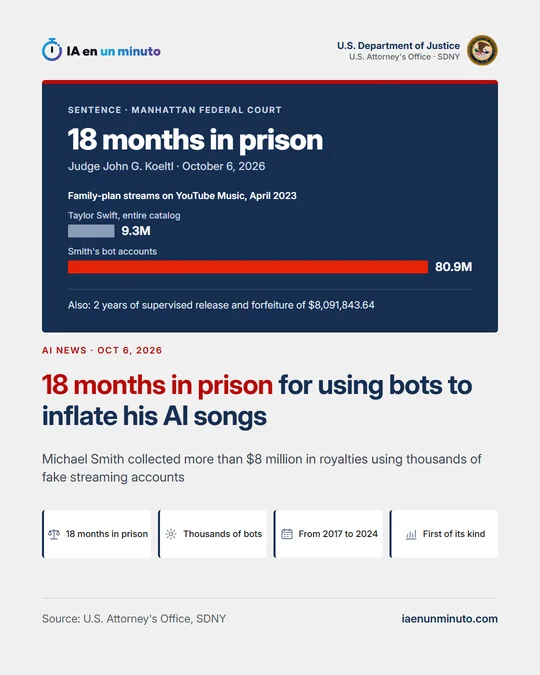
Michael Smith, of North Carolina, will serve 18 months behind bars over a fraud built on thousands of fake accounts that played songs created with artificial intelligence around the clock. Those fake streams on Spotify, Apple Music, YouTube Music and Amazon Music earned him over $8 million in royalties, paid from the pool all artists share. Smith must also forfeit $8,091,843.64 and spend two years on supervised release.
A federal court in Manhattan has sentenced Michael Smith, 54, of Cornelius, North Carolina, to 18 months in prison for a music streaming fraud that brought him more than $8 million in royalties. The U.S. Attorney's Office for the Southern District of New York announced the sentence, handed down by Judge John G. Koeltl on Tuesday, October 6.
According to prosecutors, between 2017 and 2024 Smith used thousands of fake accounts on Spotify, Apple Music, Amazon Music and YouTube Music to stream hundreds of thousands of AI-generated songs billions of times. Software made those automated accounts (bots) play his songs nonstop, and he collected royalties on those fake streams, which are paid out of a common pool shared among all artists.
One example cited by prosecutors: in April 2023, Taylor Swift's entire catalog received 9.3 million family-plan streams on YouTube Music, while Smith's bot accounts streamed his music 80.9 million times in the same month.
On top of the prison term, he will serve two years of supervised release and must forfeit $8,091,843.64. Smith pleaded guilty in March to one count of conspiracy to commit wire fraud.
According to Music Business Worldwide, the sentence is less than half of what prosecutors sought, at least 46 months in prison, and shorter than the 24 months recommended by the U.S. Probation Office; his defense had asked for no prison time. Both sides have described it as the first criminal prosecution of its kind in the United States.
Why it matters · analysis and opinion
With this sentence, inflating streams with automated accounts stops being only a matter of platform rules and comes with criminal consequences. The case also shows why music made with artificial intelligence worries the industry so much: producing songs in bulk costs little, and if bots then play them, the money comes out of the same pool that real artists are paid from. The sentence fell well short of what prosecutors sought, so the warning is there, though softer than the prosecution wanted. For labels, distributors and independent musicians, the sensible move is to distrust promotion services that promise quick streams and to check where they come from: if they come from fake accounts, this case shows they can end up before a judge.
Official source: U.S. Attorney's Office, Southern District of New York · Written with the help of AI: how we make the news