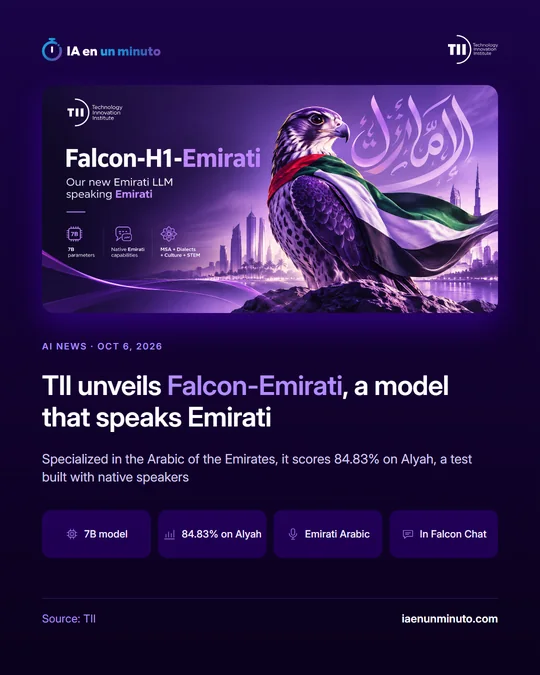
TII unveils Falcon-Emirati, a language model focused on the Emirati dialect and culture
IA en un minuto newsroom · Editor: Jon Elgezabal
In 30 seconds
Falcon-Emirati-7B, from the Technology Innovation Institute, is trained to converse in the Gulf dialect heard every day in the Emirates rather than in textbook Arabic. It gets 84.83% of the 1,173 Alyah questions right, questions written by native speakers, according to TII's own tests. It is already available in Falcon Chat, with a warning that it may stumble on unusual phrases.
The Technology Innovation Institute (TII), the creator of the Falcon models, has introduced Falcon-Emirati-7B, a language model specialized in the Arabic spoken in the United Arab Emirates.
The Arabic of news and textbooks, Modern Standard Arabic, is not the one people use in everyday conversation. In the Emirates people speak a Gulf dialect with its own vocabulary, and its proverbs and poetry do not survive a word-for-word translation.
Falcon-Emirati-7B, with 7 billion parameters, is built on Falcon-H1-Arabic, the institute's own family of Arabic models. It was trained on text from websites and forums written in the Emirati dialect, on material about the country's culture and on synthetic data generated under glossaries and style rules for the dialect.
On Alyah, a test of 1,173 questions collected from native speakers, it scores 84.83%, ahead of every model it was compared against, some of them much larger. In a second test, with a Google model (Gemini 3.7 Flash) acting as judge, it was the only one of the five models compared that reliably answered in Emirati: the others often knew the answer but gave it in Modern Standard Arabic. These are TII's own results.
It can be tried now in Falcon Chat, the institute's chat website. TII warns that it can get rare expressions wrong and recommends testing it before using it for anything official or sensitive.
TII sums it up this way: model size alone is not enough to master a dialect, it has to be trained for on purpose.
Why it matters · analysis and opinion
Knowing the answer is not enough if it comes in the wrong register, and that is the most useful lesson of Falcon-Emirati. In the judged test, the rival models often got the content right but replied in Modern Standard Arabic, and in a conversation with customers that shows. For businesses and public bodies serving people in the Emirates, a small model that talks like its customers can be worth more than a huge one that sounds like a newspaper. It should be read with caution: the results are TII's own, and the institute warns that it gets rare expressions wrong. The idea goes beyond Arabic. Any language with strong regional varieties poses the same challenge, and TII's answer is to train for it on purpose, with forum text, local culture and style rules.
Official source: TII · Written with the help of AI: how we make the news