IA en un minutoNewsSpain and Europe
OpenAI will add invisible watermarks to ChatGPT and Codex text in the EU to comply with the AI Act
In 30 seconds
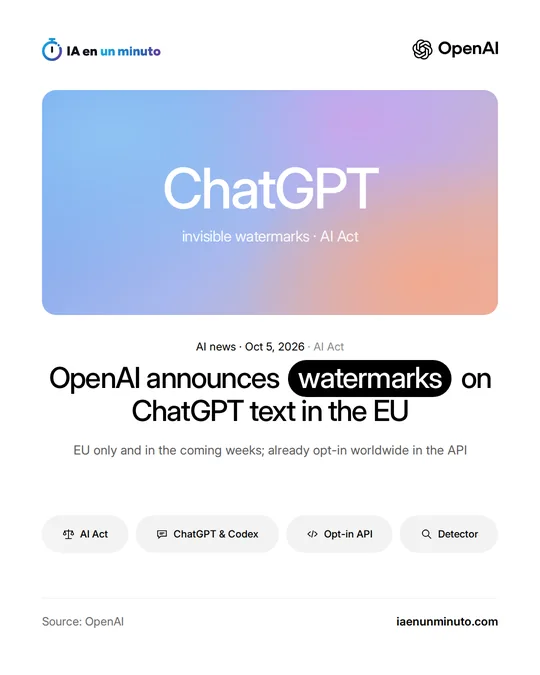
In the coming weeks, OpenAI will add invisible watermarks to text from ChatGPT and Codex, its coding assistant, in the European Union only. It is doing so to comply with the AI Act, the European AI law, which requires AI-generated text to be identifiable in a machine-readable way. For now, the detector will be limited to approved researchers and expert organizations.
OpenAI is going to invisibly mark the text that ChatGPT generates in the European Union.
The company explained today how it will comply with the AI Act, the European AI law, which requires AI-generated text to be identifiable in a machine-readable way. In the coming weeks, it will add invisible watermarks to text from ChatGPT and Codex, its coding assistant, for eligible users across all plans, in the European Union only. In the API, customers worldwide can already opt in for select models, although watermarking is off by default.
For now, the detector for these watermarks will be limited to approved researchers and expert organizations. OpenAI acknowledges that this is an early technology with significant limitations: in its tests, replacing 10% of words with synonyms reduced detection from about 92% to 66%.
Why it matters
In its tests, replacing 10% of words with synonyms reduced detection from about 92% to 66%: the watermark helps, but it is not foolproof.
Official source: OpenAI