IA en un minutoNewsSpain and Europe
El País detects AI-generated text in almost a third of the bestselling books it analyzed
IA en un minuto newsroom · Editor: Jon Elgezabal
In 30 seconds
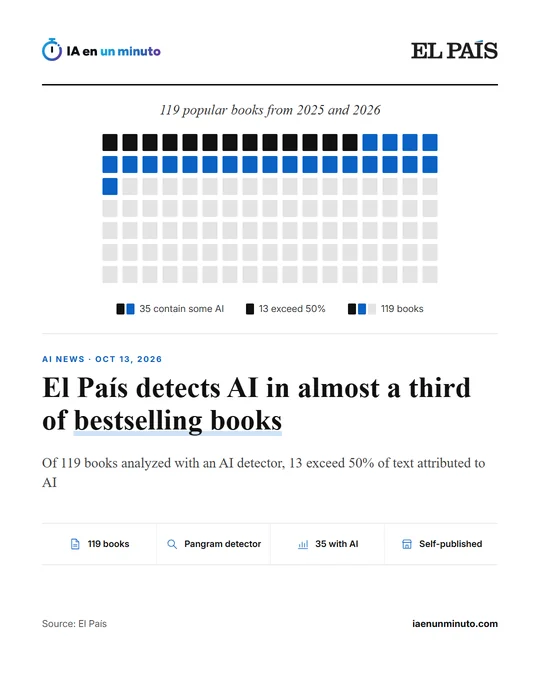
Pangram, an AI detector, finds machine text in 35 of 119 recent popular titles checked by El País. The 13 cases where that share tops 50% are self-published, with romance fiction common among them; the most prominent, at 97%, carries the name of the politician Alvise Pérez, who denies it. In 56 works from 2019 and 2020 used as a control nothing turned up, and the paper cautions that the tool can fail.
The Spanish newspaper El País has detected text attributed to AI in 35 of the 119 popular books from 2025 and 2026 that it analyzed, or 29%. In 13 of them, the share attributed to a machine is above 50%.
The newspaper gathered books for adults originally written in Spanish from the bestseller lists of Amazon Spain and Casa del Libro, from January 2025 through September 2026, and from the winners of 13 literary prizes. From each title it ran three randomly chosen 1,000-word excerpts through version 4 of Pangram, an AI detector, and then analyzed in full 12 of those that gave the strongest signal. The paper specifies that this is a sample of popular books, not a census.
The books in which AI is the majority are all self-published, and many of them are romance novels. The most visible example is "Devuélveme mi país", the book by the politician Alvise Pérez, which was number 1 on Amazon in February 2026: Pangram attributes 97% of the book to AI. Pérez replied with an email, which he shared on social media, in which he says he wrote it "word by word". The authors of the other novels the newspaper cites as mostly AI have not answered its messages.
As a control, 56 books from 2019 and 2020, which predate the current models, all scored 0%. No AI shows up either in the latest books by Javier Cercas or Isabel Allende, or in the winners of the Planeta and Nadal prizes. There is some trace in 9 books from traditional publishers, among them four nonfiction titles with between 12% and 34%.
Pangram is not infallible, the newspaper warns: in short excerpts, changing one word can alter its verdict. Nor does it indicate who used the AI or in what way. Amazon, for its part, does not ban AI-generated content: it asks that it be identified as such.
Why it matters · analysis and opinion
Self-publishing is the door through which generated text gets onto the sales charts: without a publisher's prior filter, the reader is the one who decides, often without knowing what is being bought. Amazon asks for generated content to be identified but does not ban it, so the label rests on what each author declares. For anyone who publishes, edits or commissions texts, the lesson is twofold. A detector works as a clue and not as proof, because it does not tell apart someone who asked a machine for the whole book from someone who used it to tidy up their own notes, and it can get things wrong. And trust is won through transparency: saying how a text was made is starting to be part of its value, just like the byline.
Source: El País · Written with the help of AI: how we make the news