IA en un minutoNewsSpain and Europe
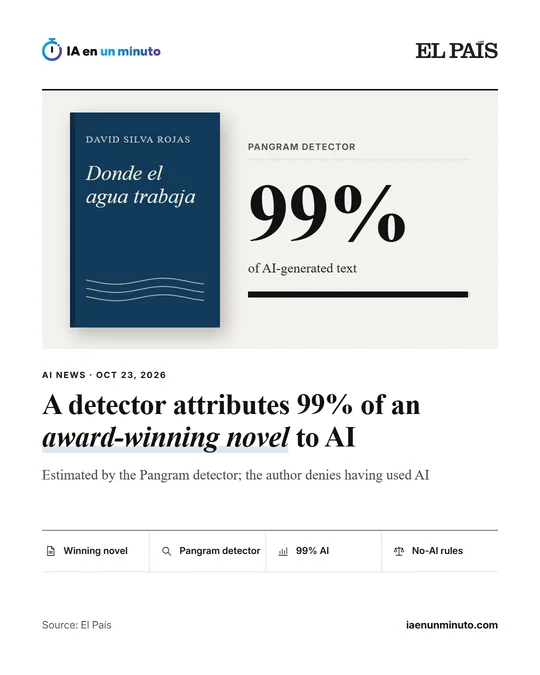
The Pangram detector estimates that an award-winning novel is 99% AI-written, according to El País
IA en un minuto newsroom · Editor: Jon Elgezabal
In 30 seconds
A novel that won a 20,000-euro contest banning AI comes out almost entirely as machine text in the test El País ran on it with Pangram: 99%. Almadía has called off the book tour and says David Silva Rojas denies having relied on AI. The paper admits the tool can get it wrong, although it raised no false alarms on books from 2019 and 2020.
The newspaper El País reported on Friday, October 23, that Pangram, a tool that estimates whether a text was written by an AI, attributes 99% of "Donde el agua trabaja", the short novel by Peruvian author David Silva Rojas, to an AI model. The paper ran the whole book, some 26,000 words, through version 4.1 of the detector. According to El País, it would be the first case of this scale in Spanish-language literature.
The book won the first edition of the Almadía Ventosa-Arrufat International Short Novel Prize in July, launched in November 2025 by the Mexican publisher Almadía and the Spanish foundation Ventosa Arrufat. According to Xataka, the prize is worth 20,000 euros and drew entries from 22 countries; El País puts the number of manuscripts submitted at 2,204. The rules required entrants to declare that the novel had not been written with AI, neither wholly nor in part, and provided for disqualification at any sign to the contrary. The jury was made up of the writers Cristina Rivera Garza, Selva Almada and Mónica Ojeda.
The book came out in September and was due to be presented from that same Friday in Madrid, Barcelona, Seville and Cádiz, but the publisher has suspended all the events. Before the article ran, Almadía told the paper that the investigation surprised it, that it had never suspected the author and that it needed time to talk to him. It then released a statement on social media saying that Silva Rojas denies having used AI and announcing "a detailed review, without anticipating conclusions".
The newspaper sets out other signs. Pangram attributes to an AI 97% of the author's answers in an interview published in September by the magazine Ulrica, while the journalist's questions and introduction come out as human text, and 80% of a piece he wrote about how the novel came about, published on the foundation's website. In that interview, Silva Rojas explained that the book's rhythm of short sentences draws on haiku. The paper acknowledges that it cannot rule out that this style confuses the detector, although it has no evidence of it, and notes that neither of the other two texts shares it.
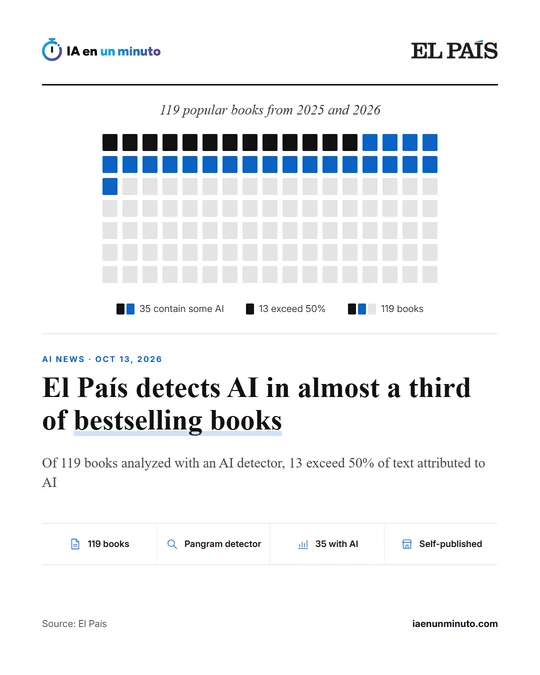
On reliability, El País points out that Pangram is not infallible: on short passages it can change its verdict if a single word is touched, although it is much more stable with long texts. According to the company's figures, it flags as AI one in every 24,000 texts written by people. In the tests the paper ran for an earlier analysis of 175 popular books in Spain, none of the 56 books published in 2019 and 2020 showed signs of AI, and the detector caught the 29 texts the newsroom had written with AI. The paper adds that a detector cannot tell whether AI was used to write with hardly any human input or to turn one's own notes and interviews into prose.
The case comes two days after it was confirmed that Canadian writer Thélyson Orélien used AI in his novel "C'était ça ou mourir", which won a prize in France; his publisher has cut ties with him after an internal investigation.
Why it matters · analysis and opinion
More and more contests ban AI, but almost none explain how they intend to check, and this case exposes the gap. A detector offers a probability, not proof, and it cannot tell letting the machine write apart from polishing one's own notes with help, which is exactly the line that rules banning even partial use force someone to draw. Without drafts or a version history, the publisher has little to weigh the author's word against the tool's. For any organization that requires AI-free work, from a contest to a company commissioning reports or translations, the lesson is practical: decide in advance what will count as evidence, ask for a trail of the writing process and do not let a percentage decide on its own.
Source: El País · Written with the help of AI: how we make the news