IA en un minutoNewsBusiness and products
OpenAI bans using ChatGPT and its models to train competing AI systems
IA en un minuto newsroom · Editor: Jon Elgezabal
In 30 seconds
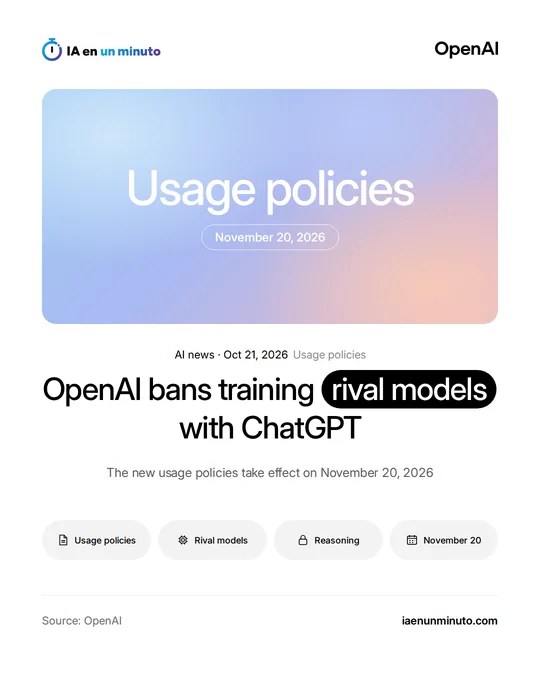
OpenAI is spelling out its rules: from November 20, 2026, nobody may use its models to produce data for training a rival AI. The rules also ban coaxing out the hidden reasoning of its models, and routers that give third parties access will need its approval. The company had already stopped a copying campaign whose core it attributes to people tied to Moonshot AI.
OpenAI released a new version of its usage policies on Wednesday, October 21, which will apply from November 20, 2026. The company says the aim is to make clearer what is allowed when building models and in sensitive uses of AI; the previous version dated from October 29, 2025.
The main change concerns training other models. The new rules forbid using OpenAI's models, or what they produce, to create, prepare, choose or provide material for training models meant to replace or compete with the company's own models or services. That covers, for example, building datasets, tasks or reinforcement learning environments; supplying labels, scores, rankings or corrections that are used in training; and choosing, filtering or validating training data. The restriction holds even when the work is done for someone else or through a third party, even if whoever does it never trains the model, and also when answers obtained while using or evaluating a product are reused for training later on.
The rules also ban trying to pull out "protected reasoning", the internal record the model follows to solve a task, which does not appear in the final answer, whether by unauthorized access, by reverse engineering or by getting around safeguards. OpenAI's justification is that training one model on another's outputs can hand over its capabilities without its safeguards. Research, software and product development, and evaluating and comparing models remain allowed, as long as they stay within those limits.
Another change affects anyone offering third parties direct access to OpenAI's models, for example model routers and AI gateways: they will first have to go through a review by the company and obtain its approval. Simply using its models inside an application is not enough to trigger this requirement. According to OpenAI, the update also brings in its national security principles, requires approval for national security and police uses, and clarifies protections for minors and the requirements for high-risk uses.
In the announcement, OpenAI explains that it has spent months working with customers and partners so that every service offering its models, whether directly, through partners that host them or through resellers, applies the same safety measures. It asks those partners for safeguards equivalent to its own, to look into possible violations and to coordinate so that restrictions hold across all services. It is also preparing SafetyIDs with its customers: identifiers that let it tell individual end users apart in an investigation without knowing who they are.
On September 30, as Infobae recalls, OpenAI said it had disrupted a distillation campaign (copying a model by training another one on its outputs) aimed at extracting that protected reasoning. The activity began on July 1 at a low volume and peaked on July 24 and 25, with 16,000 requests from more than 4,000 users; the investigation linked it to a group of more than 15,000 users, which OpenAI had fully stopped by July 28. The company is not sure whether it all came from a single actor, but it attributed the core of it to people linked to Moonshot AI, the company behind Kimi.
Why it matters · analysis and opinion
OpenAI already set limits on anyone training other models on its answers; what is new is the detail, and that detail widens the circle a lot. The rule no longer looks only at whoever does the training: it reaches anyone who generates data, scores answers or filters examples for someone else, which is common at companies that prepare datasets or at consultancies that fine-tune models for their clients. Anyone working this way with the API should check which projects end up feeding a model that competes with it, because breaking the rules can cost them access. Services that resell access, such as routers, have more urgent homework: requesting approval before the change applies. One question remains open, because the company does not spell out where it draws the line between a model that replaces it and one that simply does something different.
Official source: OpenAI · Written with the help of AI: how we make the news
What does it mean for your business? · analysis and opinion
The change mainly affects startups and small companies in Spain and Latin America that build their own AI models, agencies that prepare training data for others, and anyone offering services that give direct access to OpenAI models, such as model routers or AI gateways. For most SMEs and freelancers who use ChatGPT to write, summarize or handle customers, nothing changes in principle, and applications that integrate a model to offer a feature of their own are excluded from the authorization requirement.
The prudent step is to check before November 20, 2026 whether any project uses responses from OpenAI models to create training data, to provide labels, scores or corrections for another model, or to filter that data. The rules also cover anyone who commissions that work from a third party or acts on behalf of someone else, so it is worth asking suppliers and outside contractors how they produce the datasets they deliver. Anyone running a service that gives direct access to the models will need to request prior authorization from OpenAI.
The risk of ignoring this is very concrete: after the July campaign, the company suspended or restricted accounts. Our advice is to keep a written record of where the data used to train any model comes from, and not to try to reveal the hidden reasoning behind the responses.