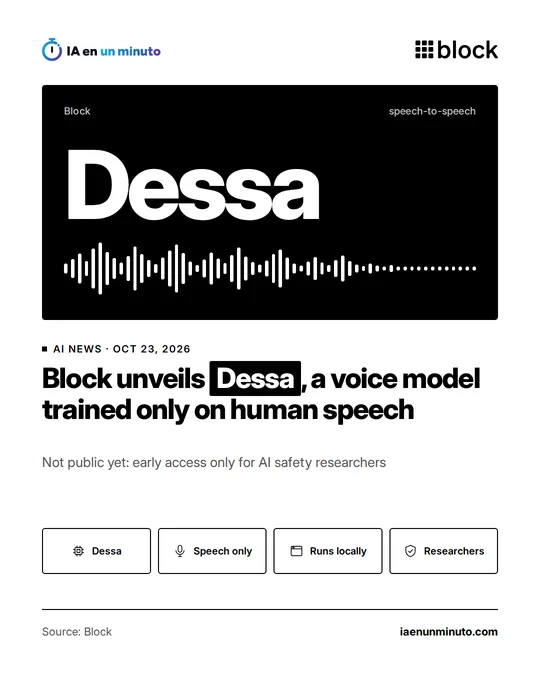
Jack Dorsey's Block unveils Dessa, a voice model trained only on human speech that is not yet public
IA en un minuto newsroom · Editor: Jon Elgezabal
In 30 seconds
Block has shown Dessa, a voice AI that learned to converse by listening to people, without ever going through text. Dessa hears and answers at the same time, picks up on emotion and works without the cloud on a MacBook Pro laptop with an M4 Max. For now only a few AI safety experts will try it, looking for risks the team has not foreseen.
Block, the Jack Dorsey company behind Square and Cash App, unveiled Dessa on Friday, October 23: a voice model that, according to its creators, was trained from the ground up only on recordings of people talking, with no text and no pretrained models. The team says that, as far as it knows, it is the first AI trained only on speech that can keep up a realistic conversation in real time.
It describes Dessa as a "speech-to-speech" model (voice in, voice out) and "full-duplex" (it listens and speaks at once, as people do). Because it learned from real chats, it knows when to jump in and when to slip in small signals like "yeah!" to show it is following; it produces its replies faster than real time and can run on a MacBook Pro with an M4 Max chip, or a more powerful machine, without the cloud. According to the team, it needed hundreds of times fewer words to learn language than a text-based language model.
Block has posted live recordings of people talking with Dessa on its website. It says nobody steers the model, which decides what to say, when and how, with its own voice and personality, and that the subtitles were added later. In one of them, Dessa talks with GPT-Live-1, a voice model from another company (OpenAI's, according to The Verge); Block notes that its developer has no ties to Block and has not reviewed Dessa. The Verge describes some of the conversations as a little awkward: in a recording shared by Dessa lead Ragavan Thurairatnam, the exchange is mostly natural, although at first the model mistakes the person it is talking to for someone called "Ronaldo".
It is not available to the public for now, and the page gives no price or release date. The team is offering early access to a small number of researchers working on AI safety so they can look for risks it did not foresee.
According to the team, today's voice systems turn speech into text and lose a great deal of information on the way: they cannot hear how someone feels or follow the rhythm of a conversation. It gives three reasons for building Dessa: curiosity, better understanding between people and AI, and safety, because a voice AI that misses emotion might not notice, for example, that someone is in severe pain.
The model comes from a small AI research lab inside Block that reports directly to Jack Dorsey, the company's cofounder and chairman, and that was set up by people who used to work at Dessa, a Toronto-based deep learning startup. The team says it has been building deep learning models since 2012 and generative voice models for more than eight years.
Why it matters · analysis and opinion
Almost every voice assistant in use today is, at heart, a text system with borrowed ears and a borrowed mouth. Dessa proposes skipping that step, and if the idea works, the difference would show where it hurts most: customer service, bookings or technical support, where a machine that cannot detect anger or hurry ends up irritating people. But for now it is a demonstration. There is no product, no price and no date, and the recordings the company itself chose still show stumbles. The sensible thing is to follow what the safety researchers find before imagining a real use. Who is behind it also stands out: the company behind Square and Cash App is entering the voice race with a tiny lab and an approach that, according to the team itself, nobody had managed before.
Official source: Block · Written with the help of AI: how we make the news