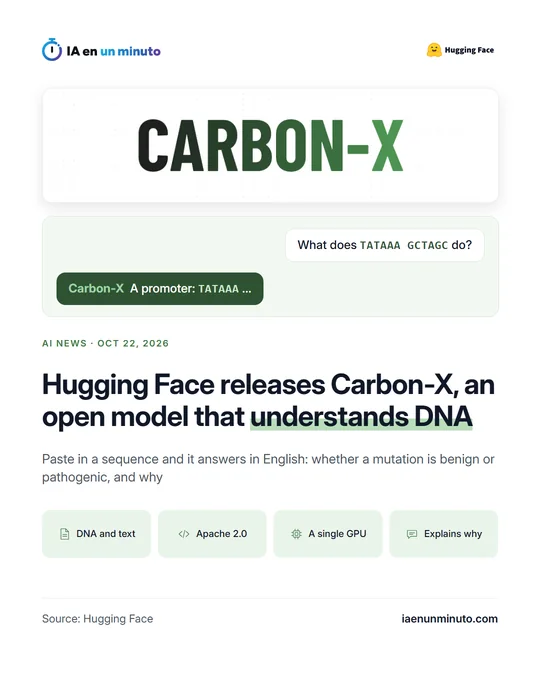
Hugging Face unveils Carbon-X, an open model you can ask questions about DNA
IA en un minuto newsroom · Editor: Jon Elgezabal
In 30 seconds
Carbon-X, Hugging Face's new open model, reads DNA sequences and replies in English when asked about them, for example what a mutation might do. On five DNA benchmarks it averages 66.7%, nearly level with GPT-6.1 Sol, for a small fraction of the cost. Hugging Face offers it under Apache 2.0, it runs on one 80 GB graphics card, and the company says it is not for medical decisions.
On Thursday, October 22, Hugging Face, the platform where AI models are shared, unveiled Carbon-X, an open model that understands DNA sequences and replies about them in English within a normal conversation. A user pastes in a sequence and asks, for instance, whether a mutation is benign or pathogenic; the model gives its verdict and walks through its reasoning. Its answers can mix text and DNA.
It can also pinpoint the parts of a sequence that regulate how active genes are, sort sequences by the group of organisms they come from and predict which bases come next.
Carbon-X has 14.8 billion parameters and is built on Qwen3-14B, an open language model. It was trained on 302 billion tokens (chunks of text) mixing DNA, biology texts, English and instructions; slightly more than half of that material is raw DNA. It was developed by Hugging Face, China's Zhongguancun Academy, and Italy's Telethon Institute of Genetics and Medicine together with the University of Naples Federico II, according to the model card and The Next Web.
In Hugging Face's own testing, on five DNA benchmarks that check whether a model can predict what a mutation does, recognize features of a sequence and guess the bases that follow, it averages 66.7%, 27 points more than Qwen3-14B. That puts it ahead of all the other open models the team looked at and close to OpenAI's GPT-6.1 Sol (67.5%), at a cost per problem roughly 1,800 times lower. On two of the five benchmarks, mutation effects in protein-coding regions and next-base prediction, it beats every model tested.
The team estimates that running Carbon-X over all 2.4 million ClinVar variants of uncertain significance (ClinVar is a public database of genetic variants) would cost roughly $300, against between $32,000 and $4 million with the frontier models it tried.
It is released under the Apache 2.0 license and fits on a single 80 GB graphics card, so researchers can run it on their own machines and hold on to sensitive or unpublished sequences in-house. Hugging Face researcher Lewis Tunstall told Business Insider, as reported by The Next Web, that viruses were kept out of the training data to lower the chance of misuse.
Hugging Face cautions that Carbon-X lacks clinical validation and is not meant for medical decision-making. Wired reported, as cited by The Next Web, that its predictions have yet to be checked in lab experiments. The model card adds that it can miscount bases or make up what a sequence does when context is missing, that it remains weak on some tasks such as spotting the points where genes are spliced, and that designing new sequences was not part of its training.
Why it matters · analysis and opinion
What is new is not that an AI reads DNA, but that it does so inside an ordinary conversation and with open weights that any lab can download and run on its own machines. That makes the first screening of genetic variants cheaper and lets patient data stay inside the institution. But the step from research tool to clinical tool is a long one: it has no clinical validation, its predictions have not yet been checked in the lab and it still slips on tasks as basic as counting bases. For genetics labs, hospitals with research groups and biotech companies, the sensible move is to try it now to decide which variants to study first, with a specialist reviewing every answer before it weighs on a decision.
Official source: Hugging Face · Written with the help of AI: how we make the news