ElevenLabs launches Eleven Realtime, its real-time speech-to-speech models for building voice agents
IA en un minuto newsroom · Editor: Jon Elgezabal
In 30 seconds
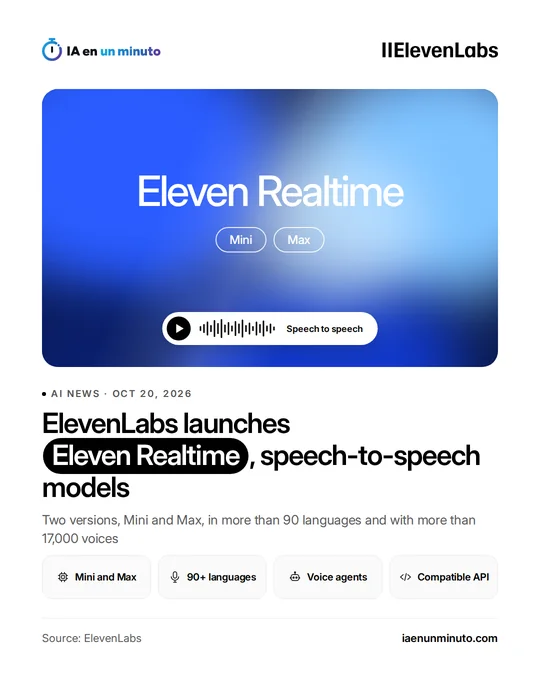
ElevenLabs is rolling out Eleven Realtime, speech-to-speech models that bring together in a single system everything an agent needs to hold a conversation on the spot. Max, the version that reasons, solved almost all the spoken questions in Big Bench Audio according to Artificial Analysis, far ahead of Mini, the cheaper one. Anyone already working with OpenAI's Realtime API can migrate by changing just two details in their code.
On Tuesday, October 20, ElevenLabs unveiled Eleven Realtime, a family of speech-to-speech models for building voice agents that listen and reply in real time. Each model brings speech recognition, turn-taking, the language model and the synthetic voice together in a single system, tuned as a whole.
There are two versions. Mini, the cheaper option, is meant for assistants, educational tutors and interactive characters, uses where the main thing is for the conversation to flow. Max adds reasoning ability for customer support, qualifying potential customers and multi-step tasks that require calling tools. Both handle over 90 languages and can draw on its library of more than 17,000 voices.
In independent tests by Artificial Analysis, Max got 98.8% of the questions in Big Bench Audio (a reasoning test with spoken questions) right, against 75.9% for Mini. That result puts Max third among the 43 models evaluated, behind StepAudio 3 Realtime (99.7%) and Qwen Audio 3.0 Realtime Plus (99.2%). As reported by Analytics India Magazine, Max also completed 87.1% of tool tasks, against 60.3% for Mini, and starts speaking in 0.57 seconds on average, versus 0.62 for Mini. Mini, however, scores slightly higher on Full-Duplex-Bench, which measures pauses, interruptions and turns: 95.8%, against 94.1% for Max.
Eleven Realtime follows the specifications of OpenAI's Realtime API (its API for real-time voice), so, according to the company, anyone already using it can move to ElevenLabs by swapping the API address and the model name. Its compatibility guide explains that the events and the WebSocket connection are the same and that OpenAI's SDK works unchanged. Anyone with a WebRTC integration will have to move it to WebSockets, according to Analytics India Magazine.
The models are available in ElevenAgents, the company's agent platform, and in the Realtime API. In ElevenAgents they are billed at the platform's per-minute rate plus the language model's cost per token; through the API, per minute of connected audio plus tokens. The launch page gives no figures and points to the pricing page.
Why it matters · analysis and opinion
Competition in voice agents is shifting from the quality of the voice to how easy it is to change provider. By adopting OpenAI's interface, ElevenLabs makes trying it almost free for anyone who already has an agent running, and forces the rest to compete on price and terms as well. For a company that handles calls or enquiries, the choice is no longer just which voice sounds best: Max is aimed at conversations involving procedures and lookups in internal systems, and Mini at simpler, cheaper interactions. What is still missing to decide with data is the real price per minute in each case and how they cope with each business's accent and vocabulary, something public tests do not capture. The sensible move is a short trial with real calls before committing.
Official source: ElevenLabs · Written with the help of AI: how we make the news
What does it mean for your business? · analysis and opinion
This news matters above all to small businesses in Spain and Latin America that already handle calls or customer queries with a voice agent, or that pay a developer to build one, especially if it runs on OpenAI's Realtime API. For businesses that do not use voice agents and have no plans to, nothing changes for now. For a company serving customers in Spanish, Portuguese or English, support for more than 90 languages could save it from building a separate system for each market.
Our advice is not to switch providers blindly. Since the technical change is small (the API endpoint and the model name), it is cheap to run a test with real customer calls and compare the results. The news points to Max for customer support and multi-step tasks, and to Mini for simpler conversations; it makes sense to try both. One caveat: according to the source, anyone connecting through WebRTC will need to move to WebSockets, something worth asking your developer about before deciding.
The news does not include prices, so the sensible thing is to check the rates before running the numbers. And there is a risk that should not be overlooked: a voice agent handles customers' voices and data, so customers should be told they are talking to a machine, and businesses should review what is recorded and where it is stored.