Anthropic shows how Claude designed proteins that bind to scorpion neurotoxins
IA en un minuto newsroom · Editor: Jon Elgezabal
In 30 seconds
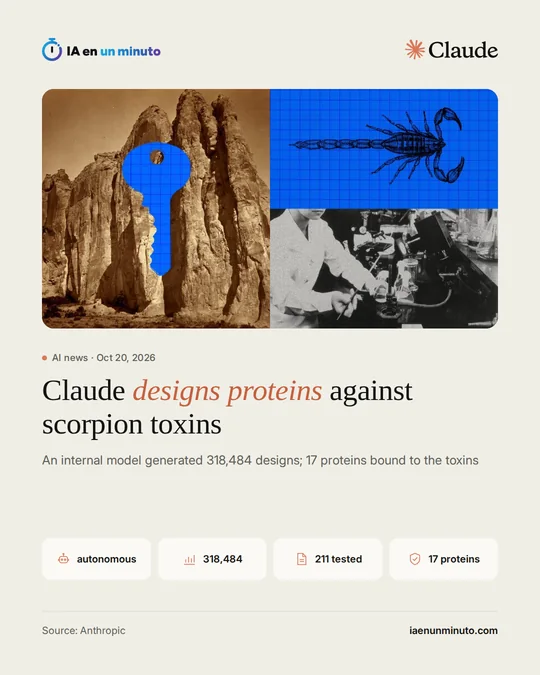
An internal Anthropic model spent 64 hours, with little help, coming up with 318,484 proteins able to grip scorpion neurotoxins. After it picked 180 and the team added another 31, two outside labs ran the tests and 17 cleared the binding bar. Anthropic stresses that it still has to show they stop the venom, so it does not talk about an antivenom.
Anthropic has described on its research blog an experiment to gauge how far AI can go in drug discovery. It asked an internal research model, running inside Claude Science (its AI workspace for scientific research, still in beta), to design minibinders against scorpion neurotoxins. Minibinders are small proteins built to latch firmly onto one specific target.
The idea came from Citrini Research, an investment research firm, which a month before Anthropic showed in August how Claude designed minibinders from a single prompt put a question to it: could AI let a group of motivated people, with no expert training, take on a real health problem? Scorpions sting 1.2 million people or more a year and cause over 3,250 deaths, mostly among children in places with poor access to medical care. Existing antivenoms are made by immunizing horses with venom collected from thousands of scorpions, a process that can take months; they usually work against only a handful of neurotoxins, and in many regions they are expensive or scarce. Because new treatments would hardly pay back their cost, scorpion stings are considered a neglected tropical disease. According to Anthropic, no binder designed from scratch against these toxins had been described until now.
The model started from an initial prompt and four follow-ups, prepared with Citrini, and worked for 64 hours mostly on its own. It went after five toxins from scorpions in Mexico, Brazil, North Africa and the Middle East. After choosing the toxin structures and the quality thresholds by itself, it used 12 design tools to produce 318,484 designs and picked 180 to be tested. Anthropic's team added another 31 with Claude's help. The whole computation took on the order of 10,000 GPU hours.
Adaptyv Bio and Twist Bioscience, two companies that run tests on contract, checked the 211 designs in the lab. Of those, 17 met the binding criteria, each one against a single toxin: none of the designs meant for several toxins at once managed it. The two best ones bind to Cn2, a toxin of the Mexican scorpion Centruroides noxius, and competition tests suggest they stick to the same spot as an antibody that neutralizes that toxin in mice.
Anthropic makes clear that it has not confirmed that these proteins neutralize the venom, either in cells or in animals, so it does not claim to have an antivenom. Before thinking about a treatment, it would need to confirm that they bind the toxin purified from real venom, measure their effect in the lab and test them in mice. Susana Vázquez Torres, of the Spanish National Cancer Research Centre (CNIO) in Madrid, and Timothy P. Jenkins, of the Technical University of Denmark, reviewed the work and see it as a promising first step; for Vázquez Torres, binding "is no longer the main bottleneck". The company is releasing the 211 designs and their data so that other researchers can work with them.
Why it matters · analysis and opinion
What stands out is not the volume of designs, but that a model did the heavy work of coming up with and choosing candidates with hardly any intervention, and that some of them passed the lab test. In neglected diseases, where almost nobody invests because the cost is not recovered, making that first phase cheaper could change who dares to try. The bottleneck, however, moves: it remains to be shown that these proteins stop the venom in cells and in animals, that they are safe and stable, and that they can be made at a good price where the patients are. In that part AI helps less, and doctors, funders and authorities are needed. To judge advances like this, it pays to look more at the trials that come afterwards than at the design announcement.
Official source: Anthropic · Written with the help of AI: how we make the news