The US Army is reportedly seeking AI agents able to infiltrate enemy networks
IA en un minuto newsroom · Editor: Jon Elgezabal
In 30 seconds
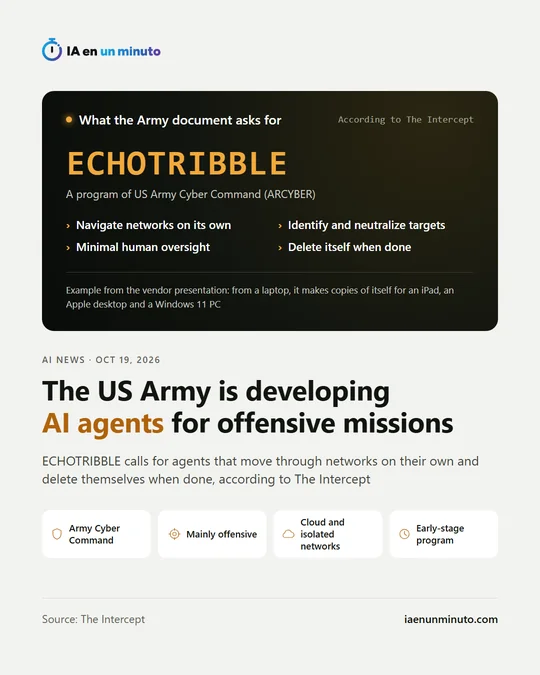
ECHOTRIBBLE is the name of the program through which US Army Cyber Command wants to send AI agents against its adversaries' computer systems. According to documents seen by The Intercept, those agents would hop from one device to another with hardly any human control and erase themselves once finished. The experts consulted fear damage to civilian networks caught in the middle.
The US Army is preparing ECHOTRIBBLE, a program to use AI agents (software that acts on its own) mainly in offensive missions against its adversaries' computer systems. The Intercept reported the plan on Monday after reviewing documents from Army Cyber Command (ARCYBER) handed out to potential contractors.
Since 2010, ARCYBER has run the Army's cyber operations: both protecting its own systems and attacking military targets, a job done until now mostly by soldiers sitting at computers. With this program it wants to hand part of those attacks over to AI.
According to one of those documents, the agents must "autonomously navigate infrastructures" and find and neutralize threats or targets. A questions-and-answers document for contractors explains that neutralizing can mean knocking the target out of action, for good or for a while, or deleting it. The Army will be able to give them some initial instructions setting what to attack and where, but after that they have to work with "minimal human oversight": move from one device to the next until they reach the target, also in the cloud and on systems cut off from any network, communicate with the Army as little as possible, hide whatever transmissions they need to make and destroy themselves at the end, ideally without the target noticing.
In a presentation shown to companies at an ARCYBER event on June 24, the example went like this: once installed on a laptop, the agent finds other possible targets on the same network by itself and builds copies of itself adapted to an iPad, an Apple desktop computer and a Windows 11 PC.
The project's official name is Agentic C2 Framework Tool (C2 stands for command and control). The project page of the Cyber Fusion Innovation Center (CFIC), which invited industry to take part together with ARCYBER and the Army Cyber Technology and Innovation Center (ArCTIC), lists the same requirements: a stealthy, lightweight agent that works with "minimal human oversight" and can be used in contested, isolated or cloud environments. According to that page, the June 24 meeting brought together 43 attendees from 29 organizations in industry, government and academia. CFIC is a defense nonprofit based in Augusta, Georgia, explains Help Net Security, which adds that a notice posted on SAM.gov on July 16 asked companies for technical papers on the tool.
The program is at an early stage, and Help Net Security notes that it is not known whether a working tool has come out of it yet. ARCYBER did not answer The Intercept's questions, including what it will do to stop the agents from causing unintended damage. The outlet points out that in recent months several AI agents, with no order to attack anything, have broken into Australian government computers or into the infrastructure of the company Hugging Face. According to Help Net Security, the program fits into the AI acceleration strategy the Department of War launched on January 12, built around seven main projects; one of them, Agent Network, covers AI agents for running battles and supporting decisions.
The experts consulted by The Intercept see risks. Hyrum Anderson, co-founder and CEO of Abundant, an AI security company, wonders what route the agent will take: whether it might go through the network of a US water utility on the way to its target and take that down as well. Anderson notes that many organizations, from critical infrastructure to small businesses, dental practices or law firms, do not have a single cybersecurity specialist on staff. David Krueger, a machine learning professor at the University of Montreal, considers it "incredibly dangerous" to give autonomous AI systems the task of neutralizing threats. William Marcellino, a behavioral scientist at the RAND Corporation, says a soldier has a sense of context that tells them what not to do, and that today's public AI does not have it.
Why it matters · analysis and opinion
The autonomy that worries anyone using agents in an office is exactly what is being asked for here as a requirement. That is the twist: what a company treats as a failure to contain becomes the goal in this program. The open question is how to limit what an agent can touch when nobody is watching it closely, and ARCYBER's silence about unintended damage does not help answer it. For civilian organizations, the risk lies less in being the target than in sitting somewhere along the way. Anyone running a small network with no specialists of their own has reason to review the basics now: up-to-date devices, two-step verification for access and backups kept off the network.
Source: The Intercept · Written with the help of AI: how we make the news