Judge denies bail to engineer accused of planting a hidden microphone at OpenAI
IA en un minuto newsroom · Editor: Jon Elgezabal
In 30 seconds
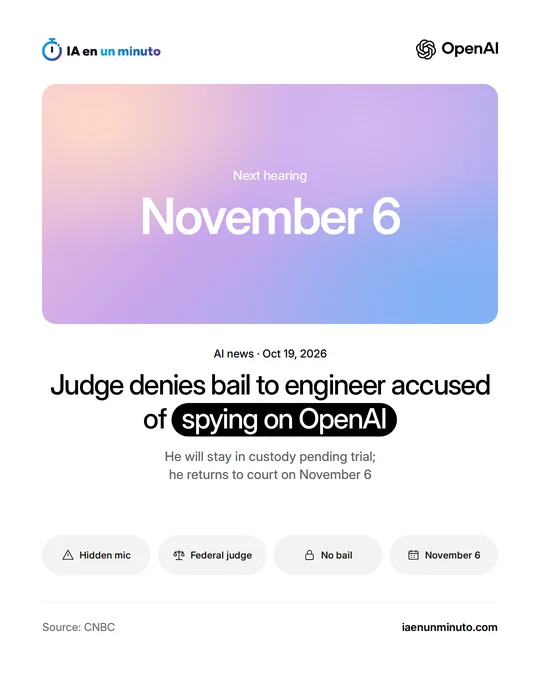
Abdulrahman Alfozan, the Saudi engineer accused of hiding a recorder inside OpenAI, will not be freed before his trial. Judge Alex Tse believes he could run and did not trust the Los Angeles Saudi consulate's offer to cover everything. Prosecutors see a threat to national security, and his next date in court is November 6.
On Monday, October 19, a federal judge in San Francisco ordered that the engineer accused of hiding a microphone in an OpenAI executive meeting room remain in custody, without bail, until his trial.
Judge Alex Tse refused to release Abdulrahman Alfozan, a 35-year-old Saudi national, on bail because he sees a "significant" risk that he would flee, according to CNBC. He also cast doubt on the value of an offer from the Saudi consulate in Los Angeles, which had pledged to cover the whole bail: "It seems like a blank check," he told the courtroom. He pointed out that Alfozan would not need to travel all the way to Saudi Arabia, a country that has not signed an extradition treaty with Washington: crossing into Canada or Mexico would be enough.
Alfozan has been held since he was arrested on October 9. He is charged with using, or trying to use, a device to intercept oral communications, an offence that carries up to five years in prison. According to the filing that prosecutors submitted on Sunday, around September 28 he plugged an audio recorder into a USB port at the back of a television, in an OpenAI executive meeting room where, on days close to that, company executives met government officials. Prosecutors argue that his conduct "could pose a danger to the national security of the United States" and that the investigation is still open and could lead to more serious charges.
The filing adds that, throughout 2025 and 2026, Alfozan chatted often on WhatsApp with a member of the Saudi royal family who tried several times to bring him into an artificial intelligence initiative in Saudi Arabia; their last contact was on October 5. Prosecutors do not name that person, nor do they say the royal asked him to install the device. They also say his wife and three-month-old son flew to Doha, Qatar, on October 10, the day after the arrest, on a business-class ticket paid for by a member of the Saudi armed forces.
His lawyer, William Pernik, asked for him to be released to home detention with GPS monitoring, and offered 1 million dollars in Alfozan's own assets on top of that. He argues that nationality does not prove someone will flee and that his client has lived in the United States for about 15 years, where he holds permanent residency and has applied for citizenship. He submitted 54 letters of support.
He is due back in court on November 6.
Why it matters · analysis and opinion
Whatever the outcome of the case, it is a reminder that the hardest threat to spot does not always arrive over the network: it can also walk in through the door with an employee badge. A room where people discuss research, customers and dealings with governments is as valuable a target as a server, and it is usually watched less closely. The judge's decision also shows how much the closeness of a foreign government weighs in a case like this, even though for now the only charge is intercepting conversations. For any company that handles sensitive information, the lesson is practical: check meeting rooms from time to time, along with whatever is plugged into screens and ports, limit who can enter them and do not assume the risk is only a digital one.
Source: CNBC · Written with the help of AI: how we make the news