Spotify changes its algorithm to keep AI-generated junk music and spam out of recommendations
IA en un minuto newsroom · Editor: Jon Elgezabal
In 30 seconds
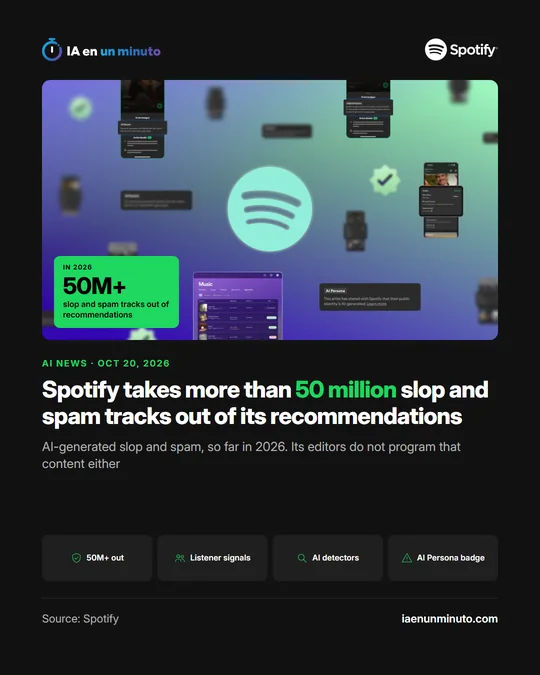
Spotify has dropped more than 50 million slop and spam tracks from its suggestions this year, after finding they were precisely the songs listeners kept skipping. To find them it combines audience reactions, upload patterns, metadata and outside AI detectors. Profiles flagged as AI Persona are also kept out of recommendations by default, and Artist Profile Protection will reach every artist before year's end.
Spotify has taken stock of the first year of the measures it announced in September 2025 to shield artists and listeners from spam, impersonation and deception in the age of artificial intelligence. In the update, posted on Tuesday, October 20, in its newsroom, the company says that so far in 2026 it has kept more than 50 million tracks of "slop" (low-quality AI-generated content) and spam out of its recommendations.
That figure is separate from the tracks it has deleted from the platform outright: according to the company, there are more than 75 million of those, taken down for serious or repeated breaches of its rules. A Spotify spokesperson confirmed to Music Business Worldwide that this is the same figure the company already gave in September 2025, covering the previous twelve months.
The change to recommendations stems from an analysis carried out early this year: looking at the songs listeners skipped, ignored or said they did not want to hear, Spotify found that, time and again, they were the ones flagged as slop or spam. Over the last six months it has rolled out many adjustments to its recommendation system to sideline them and give more visibility to music by human artists, and its editors leave them out of the playlists they put together as well. Since then, it says, listener concerns about coming across this content in recommendations have clearly declined.
No single signal is enough on its own to catch it, the company explains, so it combines several: how listeners react and what they say, upload patterns, metadata (the information attached to each song) and input from several outside AI detection tools. Spotify acknowledges that this kind of detection has limitations and will become increasingly difficult as generative AI advances. It also goes after tricks such as mass uploads, duplicates, search engine (SEO) manipulation, spam playlist networks and artificially short songs.
The update also reviews the tools launched over the past year. Thousands of profiles now carry the AI Persona label, which warns that an artist's identity is believed to be AI-generated; by default, they are left out of both editorial and algorithmic recommendations unless, for example, the listener follows that profile. According to Spotify, no other major streaming service flags these cases today. More than 300,000 artists hold the Verified by Spotify badge, which signals that there is a real, identifiable person behind the music; according to the company, they account for more than 99% of what people search for on the platform, and more than 70% of them are independent.
Since April, artists have been able to use AI Credits to declare which parts and instruments of a song were created with AI, and they now submit tens of thousands of credits a day, which show up in the song credits in the mobile app. Artist Profile Protection, the beta feature that thousands of artists have signed up for and that lets them review the releases reaching Spotify under their name and decide what appears on their profile, will be available to all artists before the end of the year. And the 1,000-stream threshold for earning royalties, in place since 2024, also slows down those who generate music in bulk: according to Spotify, tracks whose signals point to a high chance of being AI-generated are ten times as likely to stay under it.
"This work isn't finished. AI moves fast, and bad actors adapt just as fast," the company says.
Why it matters · analysis and opinion
The significant step is not deleting songs, which Spotify already did, but deciding what it stops recommending. For most artists, dropping out of playlists and the algorithm is close to disappearing, so the filter weighs as much as a takedown, though with fewer safeguards: the company itself admits its detectors have limits and that getting it right will become increasingly difficult. One open question goes unanswered in the announcement: what happens to a real musician the system mistakes for slop, and how they can appeal. Anyone releasing music already has three moves at hand: get their profile verified, state clearly whether they used AI and keep an eye on releases that come out under their name. And for those betting on uploading songs in bulk, the message is that volume no longer guarantees plays.
Official source: Spotify · Written with the help of AI: how we make the news