AI coding agents build the strategy video game Battle Drones in 321 commits
IA en un minuto newsroom · Editor: Jon Elgezabal
In 30 seconds
Battle Drones, Simon Willison's strategy game, was written almost entirely by AI agents, led by Claude Code, over 321 commits. Its author has barely looked at the code, but everything changed when he asked Claude, in Ultracode mode, for a far more fun game. Willison has also added matches between two nearby devices that exchange data through sound, with no server.
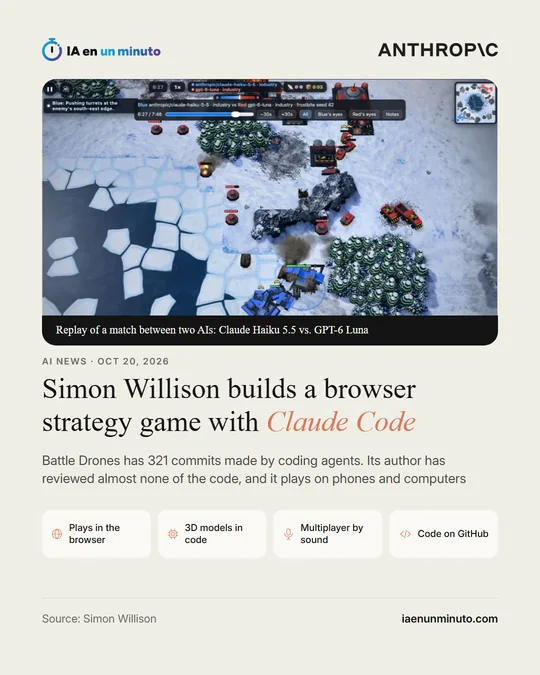
Programmer Simon Willison has released Battle Drones, a real-time strategy game in the vein of Command & Conquer that runs in the browser on phones and computers and was coded by AI agents. It can be played from its website, and the code is published on GitHub.
As he explains in a blog post on Tuesday, October 20, the game is now on its twelfth version and has racked up 321 commits (saved changes to the code) made by coding agents, mostly Claude Code, Anthropic's tool for programming with Claude. He began it in July with Claude Fable 5 and moved to Claude Opus 5.5 in October. Willison admits he has looked at almost none of the code, which is written in TypeScript, a language he has barely used, though he has playtested it a good deal.
His earlier games built this way had not turned out to be fun, and neither had the first versions of this one: the first was little more than a proof of concept, with graphics produced through OpenAI's image API, and the third, with five new maps and better graphics, still bored him quickly. Willison believed coding agents could make something that resembled a game, but not one that was truly engaging.
The leap came, he says, when he asked Claude to "Make it a LOT more fun" in Claude Code's Ultracode mode, which coordinates many agents at once. The job ran from the evening until well into the next morning, and Claude played more than a thousand simulated matches to rebalance the units and add new ones. According to the release notes, which Claude wrote itself, across 1,200 AI-versus-AI test matches on normal difficulty, games still undecided at the 25-minute mark dropped from 14% to 0.9%. Willison warns that this mode burns through huge amounts of tokens, although it can solve complex problems with a single instruction.
Claude built the 3D models of the buildings and vehicles in code, as well as the music, which uses no audio files and grows more intense as the fighting picks up. The game now has 9 buildings, 7 ground vehicles, 6 aircraft and 3 types of infantry, six maps spread over five different biomes, a random map generator, fog of war, and modes such as Last Stand, where one player survives wave after wave of enemies, and another in which the computer plays against itself. It also works offline: Willison was able to play it on a plane without having installed it.
The latest version lets two people play on two devices within microphone range, which talk to each other through sound so that no server has to be kept running. The idea grew out of Chirp Pong, an experiment of his from last week, and as far as he knows it is the first time a real-time strategy game has used this approach. Willison has tested it on laptops, iPhones and iPads, and warns that he has only just got it working. There is also a mode in which two language models play against each other, with replays of matches such as Claude Haiku 5.5 versus GPT-6 Luna.
The author says the game still lacks the effort a serious independent project demands and that he would not enter it in an event like Steam Next Fest. He makes the point in light of an IGN article reporting that players are asking Steam for a filter to hide AI-made games, because the festival is full of slop (low-quality AI-generated content). Even so, he says he can now see a path for games made this way to be taken seriously.
Why it matters · analysis and opinion
What stands out is not that an AI wrote a video game, but that the decisive improvement came from a request as vague as making it more fun, and that the model worked out the rest by testing and adjusting on its own. That shifts human work towards deciding what to ask for and judging the result, rather than writing code. Yet the case itself shows the limits: it is a risk-free project, with no code review and a token bill the author describes as runaway. In a product with customers, data or payments, nobody should accept code that no one has read. For a small team, the useful lesson is a different one: agents are already good for prototypes, internal tools and quick tests, as long as someone with judgment tests what comes out before signing off on it.
Source: Simon Willison · Written with the help of AI: how we make the news