Four Gemini 4 Argon agents beat Minecraft without human help
IA en un minuto newsroom · Editor: Jon Elgezabal
In 30 seconds
Four AI agents running Google's Gemini 4 Argon finished Minecraft from a random world, with no person giving them orders or game-specific tools. The team needed 27 hours and 14 minutes, wrote 2,783 programs and died 605 times before beating the Ender Dragon. The authors warn that it was a single game, so it does not prove the result can be reliably repeated.
Researchers at Google DeepMind released a study on arXiv on Thursday, October 15, in which four agents (AI programs that act on their own) running Gemini 4 Argon, Google's new model, were handed a single goal in a randomly generated Minecraft world: defeat the Ender Dragon, the game's final boss. The Decoder covered it on Sunday.
Nobody gave them roles or coded the game's logic for them. Each agent steered a player through Mineflayer, an open-source library for building Minecraft bots, and they organized themselves through the game chat and a memory they all shared. The researchers could follow the game live and pause or halt it whenever they wanted, yet never found a reason to step in.
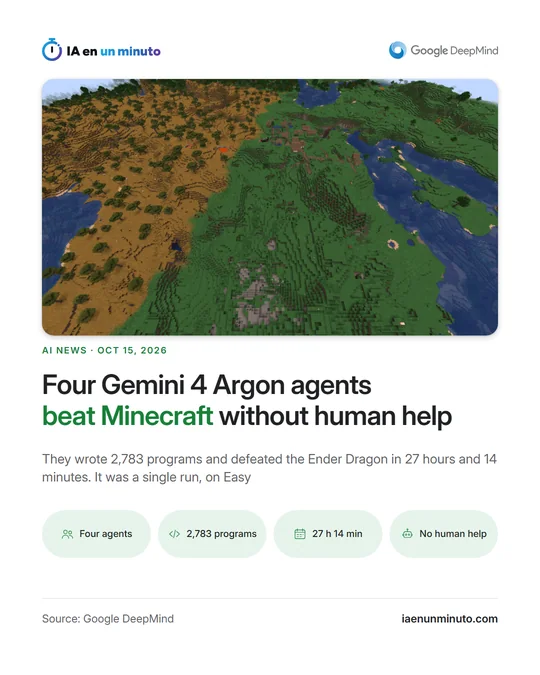
The game was played on the Java 1.20.4 version of Minecraft, in survival mode, on easy difficulty and with cheats turned off. The team got there in 27 hours and 14 minutes, after writing 2,783 programs, sending 229 messages and dying 605 times. That stretch amounts to some 81 days inside the game and includes six server restarts. According to the full paper, the agents divided up the tasks, passed on what they were learning and picked up the belongings of teammates who died; The Decoder adds that they alerted one another to dangers.
As far as the authors know, it is the first time AI agents have finished Minecraft from start to finish on their own, using only the standard Mineflayer library, with no worlds explored in advance and no game tools made by people. For comparison, the paper notes that HowLongToBeat puts the median for Minecraft's main story at 45 hours, while the record for a fast run on a random world is below seven minutes.
They estimate that, at Gemini 4 Argon's list prices, reaching the win cost about $520 at the model's launch price and about $1,040 at the standard one, which The Decoder says will apply from 2027. Counting an observer agent and the extra day of activity after the victory, the whole session cost roughly $810 ($1,620 at the standard rate).
The study itself sets out the limits: it was one game, the first one they started, and that says nothing about how reliably it would happen again. On easy difficulty, monsters do less damage and hunger cannot kill the player. Mineflayer hands the agents data a person could not interpret or cannot see, and its route module steers around obstacles, something a human does by sight; playing from the screen image, with keyboard and mouse, as SIMA 2 does, is still much harder. On top of that, Gemini 4 Argon already knew a lot about Minecraft and Mineflayer, 22% of the programs ended in an error, and the final stage, in the End dimension, took almost 14 hours.
The authors argue that complex programming and business work in the real world needs the same thing as this game: sticking to a plan over a long time and coordinating several agents.
Why it matters · analysis and opinion
What matters is not the video game but the duration: agents that hold on to a goal for more than a day, divide the work and fix their own mistakes come close to what a software project or a business process would ask of them. The jump to real use, however, has not been made yet. There was a single game, on the easiest mode and with a library that gave them information a human player does not have, so it remains to be seen whether the result repeats and how often it fails. It is also still unclear how they behave in real work settings, where a mistake has consequences. For anyone already testing agents, the practical lesson is the one the researchers themselves applied: follow them live and be able to pause them at any moment.
Source: arXiv · Written with the help of AI: how we make the news