IA en un minutoNewsBusiness and products
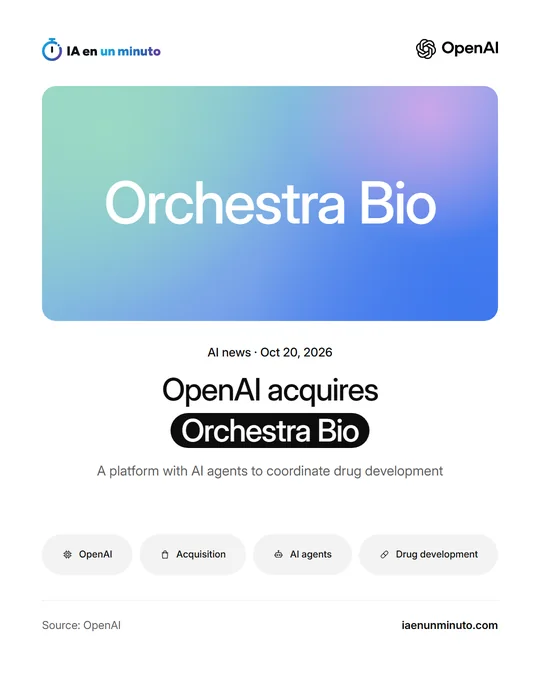
OpenAI acquires Orchestra Bio, a platform with AI agents to coordinate drug development
IA en un minuto newsroom · Editor: Jon Elgezabal
In 30 seconds
Orchestra Bio runs a platform where AI agents keep track of studies and campaigns in drug programs and flag what slips when something breaks, while the decisions stay with people. OpenAI will add that team to Rosalind, its AI offering for the life sciences. Neither company has revealed how much OpenAI paid.
OpenAI has bought Orchestra Bio, a company whose platform helps pharmaceutical and biotech teams coordinate the development of new medicines. OpenAI announced the purchase on Tuesday, October 20, on its website, and Orchestra Bio confirmed on its own site that it is joining OpenAI.
Orchestra Bio was founded four years ago, according to that page, to help these teams move their drug programs forward, work that involves thousands of decisions and dependencies spanning discovery, the preclinical stage, manufacturing and clinical trials. On its platform, people and AI agents work side by side: scientists and program leads hand off the follow-up of studies and campaigns to the agents, which frees up their time to steer the work, make decisions and tackle problems before they lead to delays.
OpenAI explains that a setback in one area of a program can ripple into many others, and gives an example: a manufacturing batch that goes wrong can push back the start of a clinical trial. In that case, Orchestra's agents help work out which tasks and deadlines are affected, pull together the necessary information and weigh possible responses. The final call stays with the scientists and program leads.
The company will fold Orchestra's team and technology into Rosalind, its family of AI models and tools for research in the life sciences. Rosalind includes GPT-Rosalind, which helps scientists reason about biology and chemistry questions, and Rosalind Workbench, which links those capabilities to scientific data and tools so researchers can analyze results and plan experiments. According to OpenAI, the Orchestra team brings experience in biotech, software and AI, and the aim is to build agents that tie scientific findings to the studies, decisions and next steps a potential medicine needs in order to move forward, so that new treatments get to patients sooner.
OpenAI points out that in the United States, developing a new medicine takes about 10 to 15 years on average, from identifying the therapeutic target to regulatory approval, and that, beyond the scientific side, teams have to coordinate internal departments and outside partners, often with systems that are not connected to each other. The company also cites its life sciences partnerships with Novo Nordisk and Moderna.
Neither company has disclosed the price or any other terms of the deal.
Why it matters · analysis and opinion
Until now, OpenAI's life sciences offering focused on helping with research: reasoning about biology and chemistry, analyzing results and planning experiments. With Orchestra it moves into another part of pharmaceutical work, program coordination, where, by OpenAI's own account, much of the difficulty is not scientific but a matter of fitting together departments, partners and systems that do not talk to each other. It is a sign that AI labs want to sell agents that become part of the daily work of regulated industries, not just models. It remains to be seen whether Orchestra will survive as a product, what will happen to its current customers and how it will be integrated with Rosalind. A biotech company weighing tools of this kind would do well to wait until OpenAI details pricing, availability and data handling before committing.
Official source: OpenAI · Written with the help of AI: how we make the news