IA en un minutoNewsBusiness and products
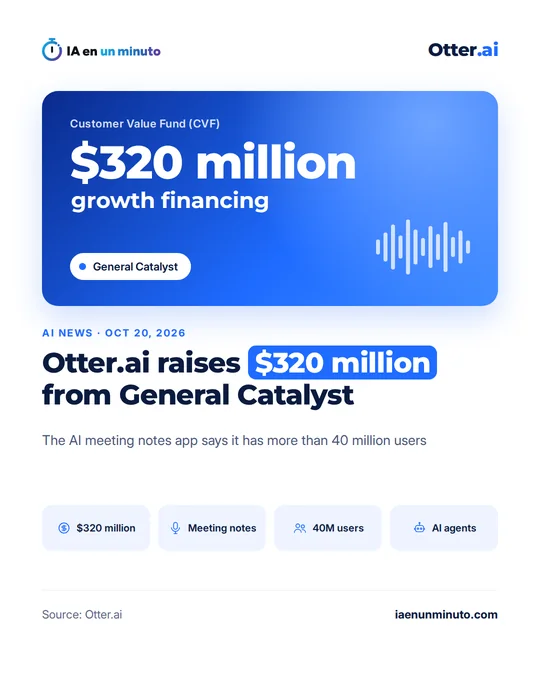
Otter.ai closes $320 million in financing from General Catalyst
IA en un minuto newsroom · Editor: Jon Elgezabal
In 30 seconds
General Catalyst is putting $320 million into Otter.ai through its Customer Value Fund, but not in exchange for shares: the company will pay it back with interest. Otter, which says it has passed 40 million users, will spend the money on selling more to businesses and growing outside the United States. The company aims to at least double its business revenue next year.
Otter.ai, the app that takes meeting notes with artificial intelligence, announced on Tuesday that it has closed $320 million in financing from the Customer Value Fund (CVF), a General Catalyst fund. The news came in a press release distributed by Business Wire.
According to the company, which is based in Mountain View, California, the money will help speed up its growth among businesses, its sales strategy, its international expansion and product innovation.
This is not a round in which the fund takes a slice of the company. Speaking to Reuters, as reported by the radio station KSEV, CEO Sam Liang explained that the money has to be returned: Otter will pay it back to the fund, plus interest, as its spending on sales and marketing turns into revenue, so existing shareholders do not see their stakes shrink. He added that the fund could put in more once this first amount has been spent.
With that money, Otter wants to multiply its sales and marketing budget by two or three, expand its small sales team and make itself better known outside the United States, its biggest market, ahead of Canada, the UK and India. According to Reuters, the company aims at least to double next year what it earns from business customers, its fastest-growing segment. Liang would not give that figure or say what share of users pay.
In the press release, Otter says it has more than 40 million users, with teams at more than 86% of Fortune 500 companies, and more than 1 billion meetings transcribed. Liang told Reuters that at those large companies Otter mostly got in because employees started using it on their own, and that it now wants to turn them into paying customers. The company plans to go public one day, but first wants to grow that business further.
According to TechCrunch, Otter had 25 million users last year and passed $100 million in annual recurring revenue. Using PitchBook data, it had raised $50 million in total until now, and its most recent round dated from 2021. The company has not shared updated revenue figures, monthly active users or how many customers leave.
In the press release, Liang says the financing will allow the company to build enterprise agentic workflows (processes run by AI agents) and to move toward a future where voice becomes "the backbone of enterprise productivity".
Over the last few years, Otter has added a meeting assistant and a search that works across apps, and it is testing a briefing sent before each meeting and an assistant that can answer questions during it, TechCrunch reports. The outlet notes that the field is crowded with rivals such as Granola, Read AI or Fireflies.ai.
Why it matters · analysis and opinion
What stands out is less the amount than the structure. Instead of selling a piece of the company, Otter takes money it will repay out of what it sells, which only pays off if every dollar spent on winning customers comes back with room to spare. It is a bet on a business that already works rather than on a promise. The challenge lies in a market full of rivals with similar products, where taking notes in a meeting has become almost a standard feature. That is why Otter is trying to move from transcribing to acting: preparing meetings, answering questions during them and pushing tasks into other tools. Anyone already using these apps at work would do well to check where recordings are stored, who can access them and whether the provider explains how it handles that data.
Source: Business Wire · Written with the help of AI: how we make the news