OpenAI says its models have improved at COBOL and other legacy programming languages
IA en un minuto newsroom · Editor: Jon Elgezabal
In 30 seconds
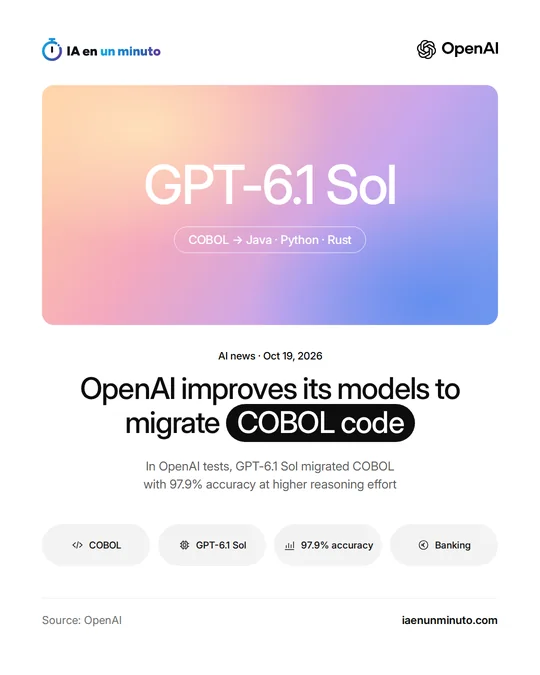
OpenAI says its newest models now code better in COBOL, Fortran and Visual Basic, old languages with little code to learn from. In its migration test, GPT-6.1 Sol got 86.6% right at low reasoning, while GPT-5.6 Sol stayed at 5.4% on that level, and it hit 97.9% with more reasoning. The company stresses that using it on real systems takes experts and testing.
On Monday, October 19, OpenAI said on its blog that its latest models have improved at writing and migrating software in older programming languages with little presence online, such as COBOL, Fortran and Visual Basic. The company explains that these languages offer far less code and documentation to learn from than Python or JavaScript, even though they underpin critical infrastructure. According to figures OpenAI cites, COBOL is behind more than 40% of online banking systems, 95% of ATM transactions and 80% of credit card payments made in person; Fortran is used in weather forecasting and in safety analysis for nuclear reactors.
To measure progress, OpenAI built two tests of its own. In the migration test, a model has to move COBOL programs to Java, Python, Rust, C++ or Kotlin without changing what they do, and it only counts as a success if it passes every hidden test, which require byte-for-byte identical outputs. GPT-6.1 Sol reached 86.6% accuracy at a low reasoning setting, against 5.4% for GPT-5.6 Sol at that same setting, for only 61% of its API cost. At a higher reasoning setting it reached 97.9%, close to the ceiling of the test.
The other test, MultiLangBench, has a model build an SQLite-compatible database engine from scratch in 20 languages. At maximum reasoning, GPT-6 Astra passed 87.4% of the tests on average, against 26.8% for GPT-5.6 Sol; in COBOL it went from 10.9% to 72.1%, and COBOL remains the hardest language. GPT-6 Luna, the cheaper option, averaged 40.3%, at an estimated cost of $0.77 per sample versus $3.48.
The company itself warns that applying this ability to software in production still needs review by experts and tests against the business rules and dependencies of each system. OpenAI invites teams to try the models through its API in the languages they use.
Why it matters · analysis and opinion
Migrating legacy systems is one of the most delicate projects in banking, insurance and public administration, because business rules often live only in the code and the people who wrote it are gone. A model that keeps the exact behavior of a program, rather than just translating it, is precisely what is needed for those migrations to stop taking years. Even so, a test designed and scored by the company itself should not be confused with a real system: a rounding error in a financial program does not show up as a failure, but as different figures. For anyone with old code, the sensible move now is to try the model on a limited part, with their own test suites, before trusting it with anything critical.
Official source: OpenAI · Written with the help of AI: how we make the news