IA en un minutoNewsBusiness and products
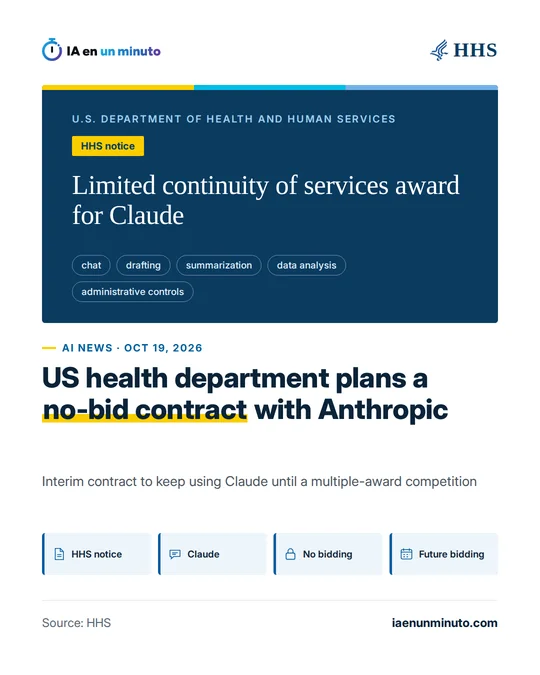
US Department of Health plans to award Anthropic a no-bid contract to keep using Claude
IA en un minuto newsroom · Editor: Jon Elgezabal
In 30 seconds
HHS, the US health department, wants to stay on Claude through a direct contract with Anthropic, without opening it to other companies, until it settles a competition with several winners. The move comes after the Trump administration's ban on Anthropic and just days before its discounted deal with agencies runs out on October 31. A public procurement expert questions the reason the department gives.
On Monday, October 19, the US Department of Health and Human Services (HHS) published a notice on SAM.gov, the federal contracting portal, announcing that it intends to award Anthropic, without an open competition, a limited continuity of services contract for Claude, the company's family of AI models. According to the notice, this is a stopgap while the department prepares a competition with several awardees to buy advanced AI models. FedScoop, which first reported the story, says it was unclear whether that competition is already open.
HHS maintains that there is only one possible provider: Claude is a model family owned by Anthropic, and what the department needs is to keep the deployment it has already built into its infrastructure. Access would cover, among other functions, chat, drafting and summaries, data and document analysis, coding help, agent features and administrative controls for authorized staff. The notice also sets conditions: the department's data is kept out of model training by default and hosted inside the United States, any security incident must be reported within an hour and, at the end, the data can be exported in a non-proprietary format and securely erased.
According to FedScoop, HHS rolled Claude out to its staff in December 2025, after Anthropic offered its services to federal agencies for $1 a year. Following the company's clash with the Pentagon, the Trump administration banned Anthropic across the government, and this year the FDA began moving its Elsa assistant, which ran on Claude, to Google's Gemini, as reported by Fierce Biotech. The legal dispute is still ongoing. In addition, Anthropic's discounted deal with agencies through the General Services Administration's OneGov program ends on October 31, a date that was already an extension of the original agreement. Neither HHS nor Anthropic answered FedScoop's questions.
Jessica Tillipman, associate dean for government procurement law studies at George Washington University, told FedScoop that the notice seems to acknowledge that the department depends on Claude. In her view, if switching providers is too cumbersome or costly, the agency negotiated badly despite the warnings, and the services described are those of a fairly ordinary chatbot, so she sees going straight to a single vendor as questionable. "That's not a normal justification," she said.
Why it matters · analysis and opinion
Dependence on an AI provider is no longer a theoretical risk: an entire US government department would rather ask for an exception to procurement rules than switch tools, even though the administration itself has banned the company. What weighs most is not so much the model as everything built around it: integration with its systems, permissions, connectors and administrative controls. Any organization deploying an AI assistant today can take note and negotiate its way out from the start: being able to take its data and logs in an open format, being able to change models without rebuilding everything else, and having a transition period. The HHS notice itself already demands something similar for when the contract ends.
Source: FedScoop · Written with the help of AI: how we make the news