Mistral launches Voxtral 3, its new voice models with an SDK for building real-time voice agents
IA en un minuto newsroom · Editor: Jon Elgezabal
In 30 seconds
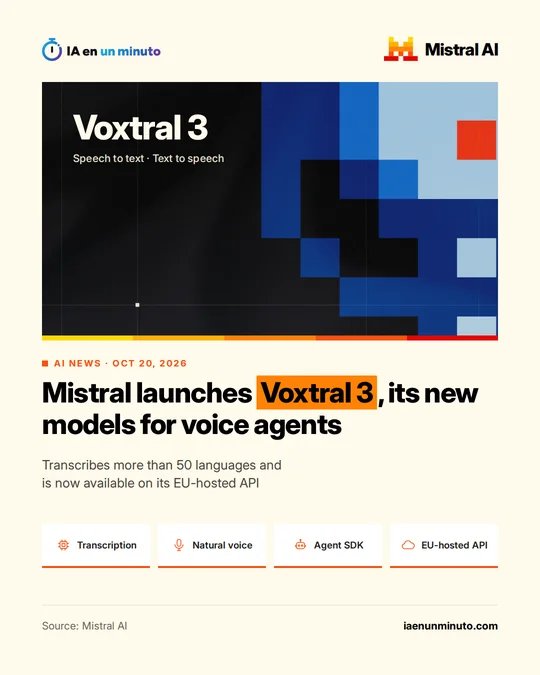
Mistral is debuting Voxtral 3, a set of models that put into writing what is said in more than 50 languages and read text aloud with the intonation each conversation calls for. Its developer kit lets companies assemble agents that answer by phone or on the web, consult tools and reply with almost no wait. It is offered through its API, with an option hosted in Europe, or installed on the organization's own servers.
On Tuesday, October 20, Mistral presented Voxtral 3, a family of models for turning speech into text and text into speech that comes with an SDK (a toolkit for developers) for building voice agents. According to the company, it can already be used through its API, which has access points in Europe, in the United States and a global one, and can also be installed on an organization's own infrastructure, so each organization controls where the audio is processed and whether it is kept.
Transcription is handled by three models. Voxtral Small Transcribe 3, the most accurate, and Voxtral Mini Transcribe 3, a lighter model with 4 billion parameters, work with more than 50 languages, among them the 24 official EU languages; they tell apart what each person says in a conversation and accept keywords to sharpen the result. According to Mistral's tests, the Small version beats Whisper, Scribe v2 and Gemini 3.5 Transcribe. The third, Voxtral Mini Transcribe Realtime 3, transcribes live with less than half a second of delay and detects when someone has finished speaking.
The speech model, Voxtral Speech 3, speaks more than 35 languages and more than 50 dialects, and fits emotion, pace and emphasis to the tone of the conversation. It can reproduce a voice from 30 minutes of audio and, according to Mistral, its price of $13 per million characters is lower than what Gemini Flash, ElevenLabs Flash, Deepgram and OpenAI TTS-1 charge for similar models.
The SDK, built on LiveKit, chains listening, reasoning with a general model such as Mistral Small, using tools and replying out loud into a single flow. Because no phase waits for the previous one to finish, each turn is completed in under a second, and the agent goes quiet if the person interrupts. During a call it can, for example, check the caller's identity, review a bill or book an appointment; it takes and makes calls over SIP, works in browsers and apps through WebRTC and connects to the switchboards and contact-center systems already in use. Each phase is a different model, so the reasoning model, the voice or the language can be changed without rebuilding the agent.
Transcription costs between $0.0035 and $0.008 per minute depending on the model, and the voice agent API costs $0.04 per minute with Mistral Small 4 as the reasoning model or $0.08 with any other. To run the whole system on its own servers or in a private cloud, Mistral asks customers to contact its team and does not publish a price. The models can be tried out in the test areas of its Studio platform.
Why it matters · analysis and opinion
Until now, building an assistant that took calls usually meant combining pieces from several providers: one to understand the voice, another to work out the answer and another to say it. Mistral offers all three together, and they can also be swapped separately, which puts it in direct competition with the big US tech companies and with voice specialists such as ElevenLabs. Its selling point is not just price but where the audio stays: for European hospitals, banks or insurers, keeping recordings inside the EU may matter more than a point of accuracy. What the page does not make clear is how much it costs to install on one's own servers, precisely the option that most interests anyone handling sensitive data.
Official source: Mistral AI · Written with the help of AI: how we make the news
What does it mean for your business? · analysis and opinion
This news matters mostly to small businesses in Spain and Latin America that handle a lot of phone calls or web enquiries: clinics, law and accounting offices, shops with customer service, or agencies that build assistants for other companies. It is not a ready-to-use app but models and an SDK aimed at developers, so anyone without technical help nearby will see it, if at all, through providers that integrate it. For a freelancer who only wants to dictate notes, very little changes.
What we see as most useful for a European company is that it can be used through the Mistral API hosted in the EU or installed on its own servers, and that each organization decides whether the audio is stored. Customer recordings are personal data, so it is worth deciding from the start how long they are kept, telling callers that they are speaking with an automated agent and reviewing the contract with whoever processes the audio.
Our advice is to start with a small trial: a single task, such as booking appointments or answering common questions, with a person reviewing the conversations during the first weeks. Transcription in more than 50 languages helps with foreign customers, but the comparison with Whisper and Gemini 3.5 Transcribe comes from Mistral itself, and the prudent step is to check it with real calls. The main risk is that an agent that uses tools makes a mistake when booking or changing something.