ElevenLabs unveils Eleven Realtime Translation, its live voice translation model, in alpha for enterprises
IA en un minuto newsroom · Editor: Jon Elgezabal
In 30 seconds
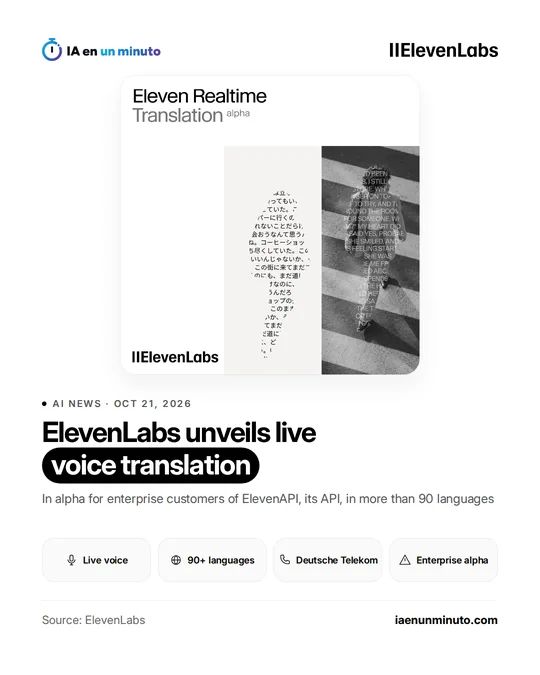
ElevenLabs has opened up, in alpha and only for enterprise customers of ElevenAPI, a model that translates spoken conversations as they happen. It covers more than 90 languages, recognizes on its own which one is being spoken and offers one of more than 17,500 voices or a custom clone. Deutsche Telekom already applies it in Magenta AI Call Assistant, and the company also pitches it to carriers and contact centers.
On Wednesday, October 21, ElevenLabs unveiled Eleven Realtime Translation, a model that translates speech live. For now it is in alpha and only enterprise customers of ElevenAPI, the company's API, can use it. With it, each participant talks in their native language and hears the other side in their own, voiced naturally and expressively, as the conversation unfolds.
By default the model relies on Eleven v4 Turbo, the company's low-latency speech model designed for real-time use, and it handles over 90 languages, detecting automatically which one is being spoken. According to ElevenLabs, a single voice stays more uniform from one language to the next, so a brand or an agent sounds the same in every market. Users can pick any of the more than 17,500 voices in its library or create a voice clone of their own, instant or professional, which does not change for the whole session.
Each deployment is tuned to the type of conversation: teams decide how soon translation kicks in, from a higher-quality version for complex calls such as billing or claims to the lowest possible latency for quicker exchanges.
The company sets out three uses. Carriers can integrate it into the calling layer of their network so that calls work across languages; contact centers can put it between agent and customer, letting a single agent serve people in many more languages with no interpreter added to the call; and at live events every member of the audience can follow the speaker in their own language.
Deutsche Telekom is already using it to develop new calling features with ElevenLabs for Magenta AI Call Assistant, its call assistant. Lena Drubel, the operator's VP of Consumer AI, described it as a new era in how voice can connect people and break down barriers.
The announcement gives no prices and no date for general availability; to get started, it points to the integration documentation and to the ElevenLabs sales team.
Why it matters · analysis and opinion
Until now, serving a customer in another language meant finding an agent who spoke it or adding an interpreter, with the waiting and the cost that involves. This launch moves the problem into the network: if translation lives inside the call, the operator can offer it to its subscribers without each business having to integrate it on its own, and the Deutsche Telekom case points that way. Everyday use still needs data the announcement does not give: price, a date for general availability and how many mistakes it makes when translating real calls. Anyone running a multilingual customer service can already start measuring which calls they lose or drag out because of language, to know whether it would pay off once it leaves testing.
Official source: ElevenLabs · Written with the help of AI: how we make the news