Microsoft attributes an AI agent attack on ConnectWise customers to a China-aligned group
IA en un minuto newsroom · Editor: Jon Elgezabal
In 30 seconds
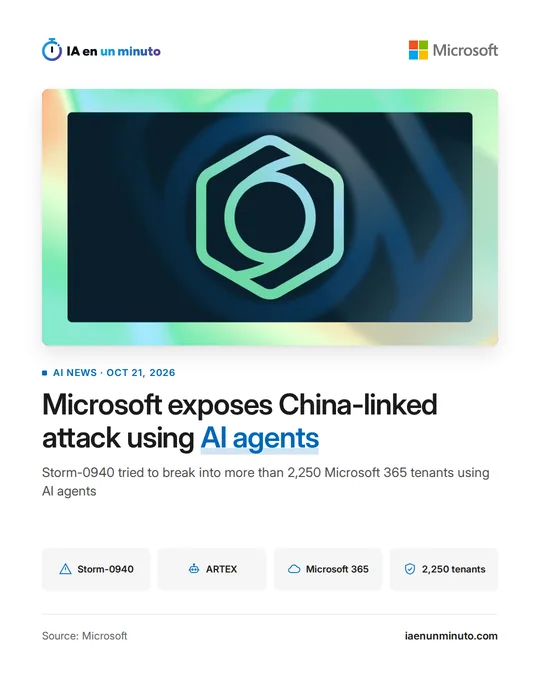
According to Microsoft, China-aligned Storm-0940 is behind the attack on ConnectWise customers and relied on ARTEX, an open-source program that splits the work among AI agents. The agents used permissions held by ConnectWise applications to test access to more than 2,250 Microsoft 365 environments, at a rate of as many as 2,900 a minute. Most went nowhere, but in several cases they reached privileged access in less than three hours.
Microsoft holds Storm-0940, a group aligned with the Chinese state, responsible for the supply chain attack on ConnectWise that the company disclosed in an advisory on October 16. It sets this out in a report its security research and threat intelligence teams published on Wednesday, October 21. According to that report, since September the group has been using ARTEX, an open-source penetration testing tool in which several AI agents do the work, against hundreds of organizations around the world in very different sectors, from defense and energy to government, semiconductors and law.
After taking control of the identities of several ConnectWise cloud applications, including the one for its Cloud Backup service, the agents used the access those applications had already been granted in their customers' Microsoft 365 environments, with no need for any user to sign in. They tried to get into more than 2,250 tenants (Microsoft's term for each organization's environment), at a pace of up to 2,900 attempts per minute. In some of those environments they went further: they carried out reconnaissance, changed application credentials to keep their access and altered identities, groups and privileged roles.
Storm-0940 has been active since 2021 and is after data. Until now it mostly got in by trying passwords on a massive scale or exploiting flaws in internet-facing applications, and it already added credentials to applications with permissions over Microsoft 365 to stay inside. What is new, according to Microsoft, is the speed: in several cases less than three hours went by between picking a target and gaining privileged access to its cloud. Most of the attempts failed. Between October 10 and 14, for example, the same infrastructure launched more than 151,000 failed attempts against 327 accounts at eight organizations, without getting in once.
ARTEX can work with any AI model and carries out a full penetration test, from reconnaissance to data extraction, with little human involvement. Microsoft says it has seen attackers from several regions using it. The report does not say which model Storm-0940 used.
Microsoft makes clear that none of this stems from an intrusion into or a flaw in its own systems, and that having one of the affected applications installed, or even the attacker managing to authenticate, does not mean data was accessed or taken. It recommends keeping connections to the affected ConnectWise applications disabled until ConnectWise publishes formal instructions to restore them, not deleting those applications as a first reaction so as not to lose evidence, and reviewing activity from at least October 15.
Why it matters · analysis and opinion
The weak point was neither Microsoft nor employees' passwords, but a third-party application that many businesses had granted broad permissions to run their backups. That inherited trust is hard to watch, and with AI agents on the other side the window to react shrinks to hours. Anyone with ConnectWise Cloud Backup connected to their Microsoft 365 should keep it disabled, save the logs before touching anything and ask their IT provider to review the sign-ins of those applications. For everyone else, it is a good moment to go over which outside applications can read the company's email and files, with what permissions, and to remove the ones no longer in use.
Official source: Microsoft · Written with the help of AI: how we make the news
What does it mean for your business? · analysis and opinion
This mainly affects small businesses, professional firms and freelancers in Spain and Latin America whose Microsoft 365 is managed by an external IT provider, and especially those who use ConnectWise Cloud Backup to back up their data. Anyone without third-party integrations holding broad permissions over their account faces less risk in this specific case, although guessing passwords at high speed is a technique that can be aimed at anyone.
The prudent step is to ask your provider whether it uses that service and, if it does, not to turn the integration back on until ConnectWise provides formal instructions to restore it, as Microsoft advises. It is also worth checking in the admin center which applications have access to the account, whether new authentication keys have appeared and whether anyone has changed administrator roles, because those are the changes the attackers made in some cases. Our advice is also to require two-step verification for every user to slow down password-guessing attempts.
The most immediate cost is operational: while the connection to Cloud Backup stays disabled, backups made with that service are on hold, and it makes sense to export the most important mailboxes and files manually. And if someone obtains administrator permissions, they can reach emails and documents containing customer data, which in the EU may require notifying a personal data breach.