An Irish youth helpline is getting more referrals from AI chatbots
IA en un minuto newsroom · Editor: Jon Elgezabal
In 30 seconds
Text About It, which supports young people in Ireland by text message, is getting more cases sent by AI chatbots, and Sinead Keane of spunout.ie put the referral rate at 14%. Keane told the Irish parliament that these people arrive in more distress than those who write in on their own. Niall Muldoon, the Ombudsman for Children, warned that EU rules do not treat these chatbots as high risk, so they are not watched closely enough.
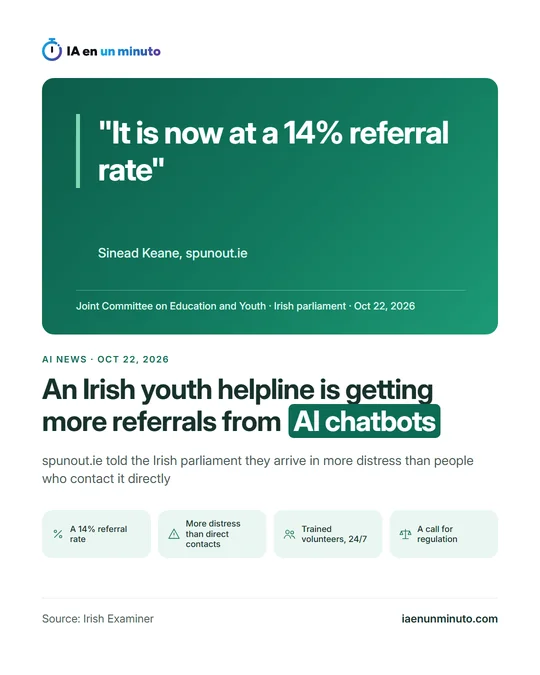
spunout.ie, a free helpline for young people in Ireland that is open around the clock and funded by the HSE, the Irish public health service, is receiving a growing number of people referred by AI chatbots. Sinead Keane of spunout.ie described the trend on the morning of Thursday, October 22, before the Irish parliament's Joint Committee on Education and Youth, which met to discuss mental health support in schools and youth services, as reported by the Irish Examiner.
According to Keane, Text About It, the spunout.ie text messaging service run by trained volunteers, has had more referrals from chatbots in recent months. "It's now at a 14% referral rate," she said. The report does not specify what total that percentage is calculated against.
Keane added that, from what they are seeing at this early stage, these people are "coming to us at a higher rate of distress than if they came to us directly", which means it takes longer to calm them down. In her view, the situation shows that the area needs regulation, to protect the whole population and not only young people.
Roughly one in eight conversations opened on the service in September dealt with school, according to Keane. The topics that come up most are stress and anxiety, with loneliness, suicide and depression close behind.
At the same session, Ireland's Ombudsman for Children, Niall Muldoon, pointed out that the EU AI Act does not currently classify chatbots as high risk. "They are considered a medium risk so they don't get monitored in the way they should be," he said. He called for a move towards the principle of "safe before sale", so that nobody can have a chatbot unless it is safe, and said the children his office speaks with are clear that they do not want chatbots to help them with health or mental health issues.
Why it matters · analysis and opinion
A chatbot pointing someone to a helpline is, in principle, what it is supposed to do: recognize a crisis and hand over to people. What spunout.ie describes is what happens before that referral, because those who arrive this way are in a worse state than those who write in of their own accord, and the cost falls on a service funded with public money and run by volunteers. It remains to be seen how long these young people spend talking to the machine before being given the contact and what it tells them in the meantime, something the report does not clarify. For anyone building or deploying conversational assistants, the Irish debate points to where requirements in Europe may be heading: less trust in the maker's word and more safety testing before reaching the market, especially if the product may end up talking to minors.
Source: Irish Examiner · Written with the help of AI: how we make the news