Illustrator Axel Scheffler is considering suing OpenAI over images similar to his work
IA en un minuto newsroom · Editor: Jon Elgezabal
In 30 seconds
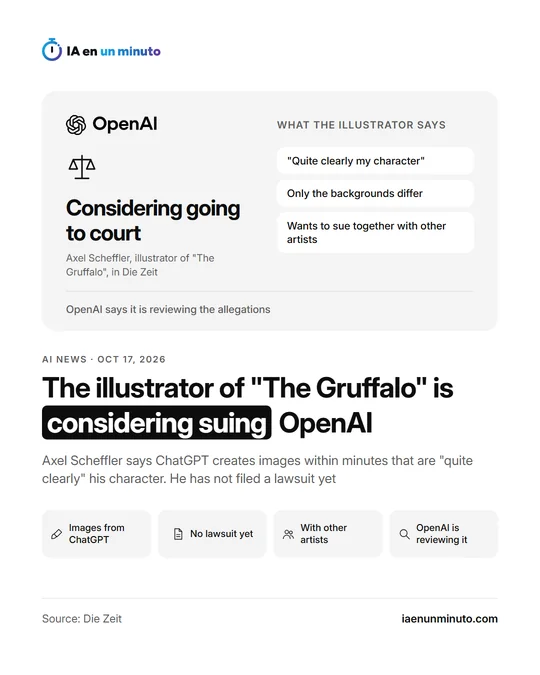
Axel Scheffler is thinking of taking OpenAI to court: he argues that ChatGPT draws, in minutes, figures that are his Gruffalo except for the backgrounds. There is no lawsuit yet; he would rather act with other artists and is in talks with his publishers about their support. OpenAI says it is examining the claims, and in Germany Penguin Random House is already suing the company over the work of Ingo Siegner.
Axel Scheffler, who illustrated "The Gruffalo", is weighing a lawsuit against OpenAI because ChatGPT, its AI assistant, turns out pictures that look very much like his character. He said so in an interview with the German weekly Die Zeit that came out on Saturday, October 17, as reported by the dpa news agency.
"I am considering taking legal action," said Scheffler, who draws with traditional methods. Die Zeit showed him what ChatGPT does when someone asks it for a Gruffalo: within minutes it comes up with drawings that, to the illustrator, are "quite clearly" his character. "I'm appalled," he added; "only the backgrounds look completely different to how I draw them."
No lawsuit has been filed so far. He would rather go to court alongside other artists, he is discussing possible backing with his publishers and, according to heise online, he is also seeking legal advice.
OpenAI replied that it is looking into the allegations. "We respect the rights of creators and content owners," the company said, adding that it is holding "productive conversations" with many publishers worldwide so they too can make the most of this technology.
It would not be the first case of its kind. In Germany, Penguin Random House, which publishes the children's series "Coconut the Little Dragon", has already sued OpenAI over Ingo Siegner's books, backed by the country's publishers and booksellers association, the Börsenverein des Deutschen Buchhandels. The publisher says simple prompts are enough for ChatGPT to reproduce material from those works in a recognizable way and, as Salzburger Nachrichten reports, the chatbot draws the character almost exactly like the original and offers, unprompted, to prepare a print-ready manuscript with a cover and back-cover copy. Heise adds that it is the first book publisher in Europe to take OpenAI to court, and that the publisher Carlsen has also sued the company over "NEINhorn", by Marc-Uwe Kling and Astrid Henn.
In its response to that lawsuit, OpenAI argues, according to Die Zeit as reported by heise, that an AI does not store data the way a database does and that its models do not hand back content word for word but learn patterns to create new content. Also in Germany, the music rights society GEMA has already won a court case against OpenAI about song lyrics.
Why it matters · analysis and opinion
The case opens a different front from the one over texts: the dispute is less about what the model was trained on than about what it hands the user, a recognizable character at the first request. In children's books, where the story lives in the drawing, that strikes at the heart of the business, and it helps explain why the German lawsuits come from that sector. That an illustrator prefers to litigate as a group and seeks the backing of his publishers shows how hard it is for an author to take on a big tech company alone. Anyone using image generators for commercial material would do well not to ask for well-known characters by name and to keep the prompts they use: what gets published remains the responsibility of whoever publishes it, whatever the courts decide about the provider.
Source: Yahoo News (dpa) · Written with the help of AI: how we make the news