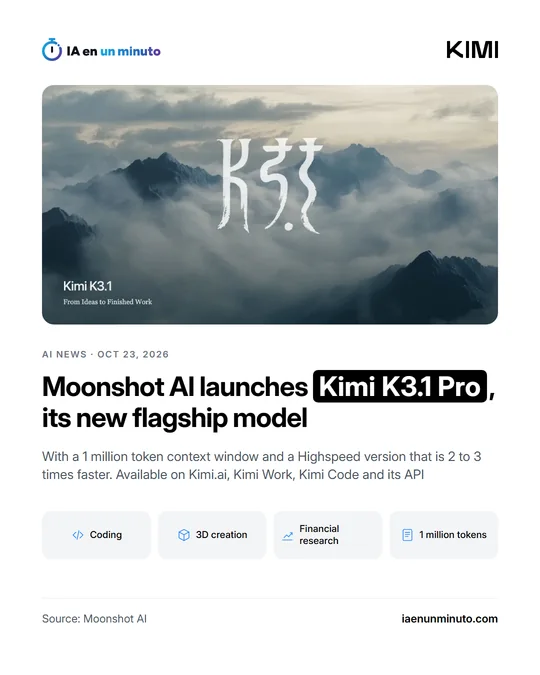
Moonshot AI launches Kimi K3.1 Pro, its new flagship model
IA en un minuto newsroom · Editor: Jon Elgezabal
In 30 seconds
Kimi K3.1 Pro opens Moonshot AI's K3.1 series with a context of 1 million tokens, and its open weights will arrive by November 4 at the latest. The Highspeed variant keeps the quality and runs roughly 2 to 3 times faster. On Terminal-Bench 4.0 it gets 65.7%, above GPT-6 Astra and just short of Claude Opus 5.5, according to the company's own figures.
Moonshot AI, the company behind Kimi, has unveiled Kimi K3.1 Pro, the first in its new K3.1 series. According to its technical blog, it is its most capable open-weight model so far within the 3 trillion parameter class, and it supports a context window of 1 million tokens (the amount of text it can take into account at once). The company says it brings notable gains in coding, 3D creation and financial research. It builds on Kimi K3, which received far more computing power in the tuning stage that follows initial training.
Alongside it comes Kimi K3.1 Pro Highspeed, a variant that, according to the company, offers the same quality at roughly 2 to 3 times the speed. Both are available from today on Kimi.ai and its apps for iOS, Android and HarmonyOS; on Kimi Work, its desktop app for Windows and Macs with Apple chips (version 3.1.0 or later); on Kimi Code, its coding tool; and through its API (the connection for developers), under the names kimi-k3.1-pro and kimi-k3.1-pro-highspeed. On Kimi business accounts, access is switched off at first and each administrator turns it on. The blog gives no API prices.
On Kimi Code, K3.1 Pro is available from the Plus (Moderato) plan and the fast version from the Pro (Allegretto) plan; the 1 million token context also requires Pro or a higher plan. The models in the series only work with reasoning mode switched on, at three levels: low, high and max.
On Terminal-Bench 4.0, a test that measures coding agents (AI that carries out tasks on its own) on realistic command-line tasks with limited resources, K3.1 Pro scores 65.7%. It beats GPT-6 Astra (58.2%) and comes very close to Claude Opus 5.5 (66.4%). On BenchCAD, which assesses rebuilding 3D parts from several views through CAD code, it reaches 92.7% with tools, below Claude Opus 5.5 (96.2%) and GPT-6 Astra (95.9%). All of these are results published by the company itself.
The model weights (the files for installing it on in-house computers) will be released no later than November 4. For that open version, Moonshot AI explains that it located and removed cybersecurity-related data from two stages of training, in order to reduce the risk of misuse. On its internal vulnerability exploitation test, a version without that cleanup solved 90.5% of the problems, and the final model 81.0%. According to the company, its capability in this area remains behind that of leading closed models that have been publicly available for at least three months.
Why it matters · analysis and opinion
What matters is not the test where it comes second, but the promise to release the weights: a company that wants a model of this level on its own servers, without sending data outside, will soon have one more option. It remains to be seen what hardware is needed to run it in-house, something the announcement does not detail, and the blog gives no API prices to compare either. The decision to remove cybersecurity data also opens a practical debate: it lowers the risk of misuse, but leaves the tool somewhat behind for anyone who wants to use it for defence. Before switching provider, the sensible step is to try it on the team's real tasks and not rely only on the tests each company publishes.
Official source: Moonshot AI · Written with the help of AI: how we make the news