Texas Attorney General sues OpenAI and Sam Altman over alleged deception about the risks of its chatbot ChatGPT
IA en un minuto newsroom · Editor: Jon Elgezabal
In 30 seconds
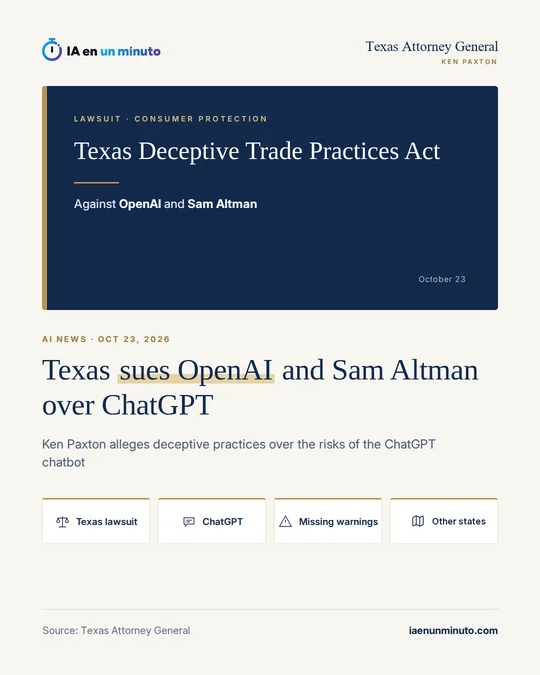
Ken Paxton is taking OpenAI and its boss, Sam Altman, to court: the Texas Attorney General's office argues that ChatGPT was sold as safe without warning of the risks. The state wants up to $10,000 per violation, Altman held liable in person and an independent evaluator before every new model in Texas. Florida and eight other states had already sued the company this year.
Texas Attorney General Ken Paxton filed a lawsuit on Friday, October 23, against OpenAI and its CEO, Sam Altman, in a district court in Collin County. According to the complaint, the office argues that the company sold ChatGPT, its chatbot, as a safe and reliable tool without warning of its dangers, and accuses it of breaking two state laws: the Deceptive Trade Practices Act, Texas's main consumer protection law, and the SCOPE Act, which protects minors online.
The Attorney General's statement lists the harms it blames on the use of ChatGPT: mass shooters who allegedly received help, vulnerable people pushed toward suicide, users who allegedly lost critical thinking skills and minors hooked on a tool that, according to the text, imitates human compassion to collect their data without parental control. These are accusations a court will have to resolve. Paxton adds in the statement that OpenAI has a responsibility to protect its users and to warn them about the dangers of its platform.
Texas is seeking penalties of up to $10,000 for each violation, Altman held personally liable, the disgorgement of the defendants' assets and a jury trial. Among the measures it asks the judge to order are barring OpenAI from offering ChatGPT to minors in Texas and from releasing any new AI model there unless an independent evaluator, approved by the court, has reviewed its safeguards and cleared its release.
Texas is not the first state to take this step. Florida sued OpenAI in June, and on Wednesday, October 14, Iowa, Kansas, Nebraska, West Virginia, Arkansas, Arizona, Idaho and Montana each did so in their own courts, according to CNBC. With Texas, there are now at least ten, according to Infobae. Responding to the October lawsuits, OpenAI spokesperson Drew Pusateri told CNBC that the company has built in age-specific protections that "many other AI products lack"; according to Infobae, the company had not responded publicly to the Texas lawsuit.
Why it matters · analysis and opinion
The request that goes furthest is not the fine but the prior check: if a judge agreed that an outside evaluator must approve each model before it reaches Texas, a state would be setting, through the courts, something close to a launch licence. A ruling will take time, but the pile of state lawsuits is already pushing in one direction: checking age, warning clearly about risks and documenting safety testing. Anyone building ChatGPT or another chatbot into a service open to the public, especially one minors can use, would do well to review now what it tells users, how it verifies their age and what record it keeps of its testing, because those are exactly the questions the attorneys general are asking.
Official source: Texas Attorney General · Written with the help of AI: how we make the news