The World Bank launches its first digital strategy to prepare developing countries for AI
IA en un minuto newsroom · Editor: Jon Elgezabal
In 30 seconds
The World Bank Group has rolled out a digital plan in Seoul built on four pillars, ranging from internet access to artificial intelligence. It wants private help to cut the price of phones and broadband, and to promote AI built for local problems, such as spotting disease on farms. It will also offer emerging-market governments shared compute, first in Africa and Latin America, with NVIDIA and Cassava Technologies as partners.
The World Bank Group unveiled its first digital strategy on Tuesday, October 20, in Seoul. It pools what the institution can offer the public and private sectors toward one goal: that developing countries widen affordable access to digital technology, improve their services and generate employment. The organization argues that digital tools can help create work in its five priority sectors: infrastructure and energy, agribusiness, health care, tourism and value-added manufacturing.
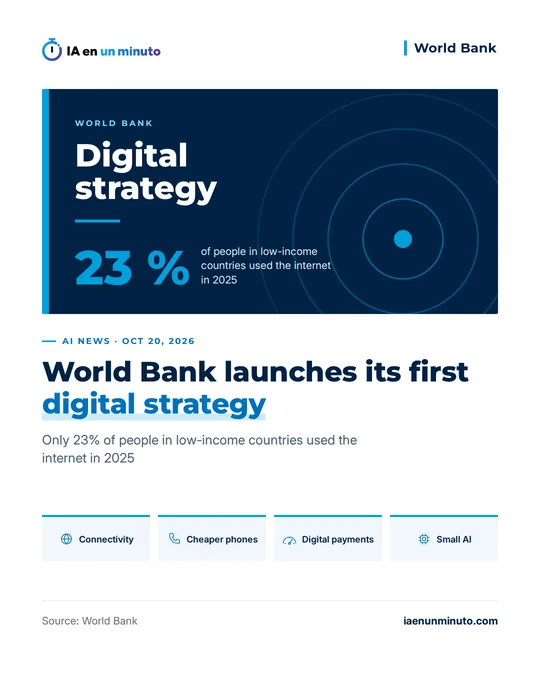
The plan rests on four priorities: broader connectivity, more affordable devices and data, stronger digital services and skills, and helping countries lay the groundwork to benefit from artificial intelligence. On connectivity, it aims to close gaps along the whole network, from international cables to the links that reach homes, businesses, schools and clinics, through shared infrastructure, more competition, and public financing and guarantees that draw private investment into underserved markets. Where electricity and connectivity are both lacking, it proposes planning them together.
To make basic smartphones and broadband cheaper, it suggests alliances with manufacturers, mobile operators, financial institutions and refurbishers, which can also widen responsible installment payment options. It will also back dependable systems for digital ID, payments and secure data sharing, along with digital skills training tied to jobs. Privacy, cybersecurity and fraud protection cut across all four priorities.
On AI, the focus is on "small AI": tools fitted to specific jobs and local conditions, such as helping farmers recognize crop disease, assisting health workers or helping firms keep track of inventory. Alongside the strategy, the institution announced the AI Infrastructure and Readiness Initiative, which seeks to give governments in emerging markets affordable compute through shared GPUs paid for by use (specialized processing power for building and running AI applications), as an alternative to building their own national data centers. Africa and Latin America come first, and its knowledge partners include NVIDIA and Cassava Technologies. Group President Ajay Banga spoke of "the promise of small AI—AI for the people."
According to the institution, in developing countries 1.2 billion young people will come of working age within the next 10 to 15 years, yet their economies are expected to add only about 420 million jobs. In 2025, more than 2 billion people around the world had no internet connection. Just 23% of the population in low-income countries went online, against 94% in high-income ones, and many people live within network range but cannot pay for a phone or data, or lack the skills to use them. The statement gives no figures on funding, no timelines and no list of participating countries.
Why it matters · analysis and opinion
A development bank putting artificial intelligence into its first digital strategy shifts the conversation: AI stops being seen as a matter for major powers and starts being treated as basic infrastructure, just like the power grid or cables. Betting on small tools and compute rented by usage is realistic for countries that cannot afford their own data centers. But the order of the priorities weighs more than the headline: without connectivity or affordable phones, no application reaches the farmer or the health worker. NVIDIA appearing among the partners shows that the chip industry is also looking at these regions. What is missing to judge the plan is amounts, timelines and specific countries, which the statement leaves for later.
Official source: World Bank Group · Written with the help of AI: how we make the news