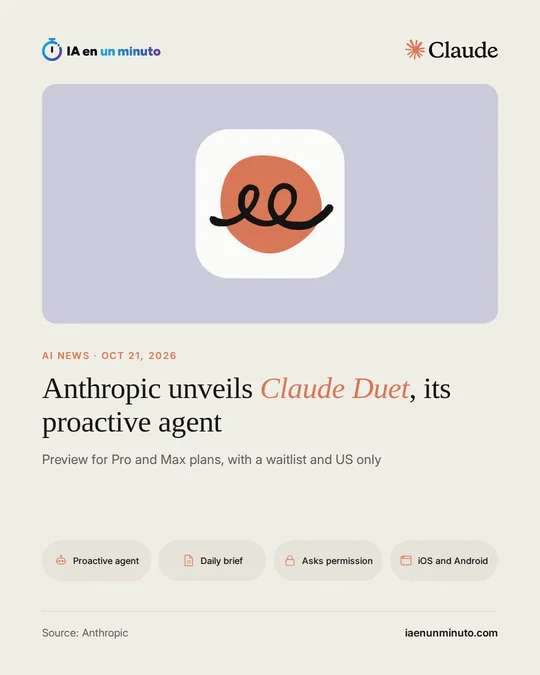
Anthropic unveils Claude Duet, an app where Claude acts as a proactive agent, in preview
IA en un minuto newsroom · Editor: Jon Elgezabal
In 30 seconds
Anthropic has launched Claude Duet as a trial, an application where the assistant takes the initiative: each morning it sums up what is relevant in the linked tools and only interrupts when something is pending. It can handle long jobs without the phone being on, although it asks before sending, paying or signing. For now it reaches Pro and Max subscribers in the United States who join the waitlist.
On Wednesday, October 21, Anthropic opened a research preview of Claude Duet, a new app in which Claude operates as a proactive agent: rather than waiting to be asked, it flags what requires attention, carries out the jobs it is given, keeps going while the user is away and consults them before acting on their behalf. The company says it has in mind professionals and small business owners who have more on their hands than they can keep up with.
Every morning it sends a brief summary of what matters most in the connected applications and, during the day, only writes when something needs the user. To avoid using up the plan's limits too quickly, it looks at the linked accounts every few hours rather than continuously. It accepts all kinds of assignments, from setting up meetings to preparing financial or sales forecasts, putting together dashboards, making prototypes or creating web apps. It runs on a virtual machine that has its own browser, which means the laptop or phone can stay off, and it sends an alert when a task is finished or needs reviewing. Users can type or speak to it in a single conversation thread, and it inherits memory, skills and connected apps from the Claude account.
Before sending a message, making a payment, signing a document or deleting something, it displays the planned action and holds off until it gets the go-ahead. Some things it will not do even with permission, such as buying or selling securities or transferring money between accounts. It can use more than 6,000 connectors and plugins, including Slack, Gmail, HubSpot, QuickBooks, Shopify, Canva, Docusign or Gusto, and buy for the business with Link, Stripe's digital wallet, which asks for the spending to be approved and pays with a virtual card. According to Anthropic, Duet never directly sees passwords or access tokens, and it debuts a classifier that refuses to share the most sensitive data, such as card numbers or identity documents; other data, such as health or personal finance information, is only sent if it is expressly instructed to.
It comes as a separate app for iOS and Android and also works on claude.ai, and Anthropic built it around Claude Opus 5.5, one of its models. During the preview it is part of the Pro and Max plans and shares their usage limits with the rest of Claude: background checks count, and big tasks use up more. Access is through a waitlist, and the first to get in are Pro and Max subscribers based in the United States. Anthropic warns that this is an early version: it can misinterpret a conversation or get wrong what is urgent, it does worse with personal errands such as booking tickets, it cannot yet show its browser and, for now, it lives outside the main Claude app.
Why it matters · analysis and opinion
Until now, AI assistants answered when someone wrote to them; Duet reverses that relationship and decides on its own what deserves an interruption. That is the underlying change and also the challenge, because an agent that alerts too much ends up muted and one that stays quiet loses its reason to exist. The focus on professionals and small businesses is no accident either: they are the ones who pile up the most loose tasks and have the fewest hands to share them out. The limit is set by trust, because the more access the agent has to email, invoices or payments, the more each approval weighs. That some actions stay barred even with permission shows the company prefers to move slowly where money is involved. Outside the United States, for now, the only option is to watch how it develops.
Official source: Anthropic · Written with the help of AI: how we make the news
What does it mean for your business? · analysis and opinion
For now the app reaches very few people: Anthropic has only opened it in the United States, with a waitlist and for the Pro and Max plans. A freelancer or small business in Spain or Latin America that already pays for Claude Pro or Max cannot use it yet, so it makes no sense to change plans just for it.
The useful thing right now is to get ready. It is worth reviewing which apps are connected to the Claude account and what its memory holds, because Duet inherits those connections, the memory and the skills. Our advice is to start, when it arrives, with a work email or calendar rather than a personal one, and to delegate low-risk tasks first, such as scheduling meetings, before handing it anything that touches payments or customers.
The cost is not a new fee, but it is not free either: background work uses the same usage limits as the plan, so a very active agent can leave less room for everything else. As for risk, Anthropic says Duet never directly sees passwords, checks with the user before acting and refuses to share credit card numbers or government identification; even so, the prudent approach is to read every approval before accepting it, because an agent that reads email and sends messages is constantly deciding where information goes.