Google gives every Gemini agent its own isolated computer and will open that system to its customers
IA en un minuto newsroom · Editor: Jon Elgezabal
In 30 seconds
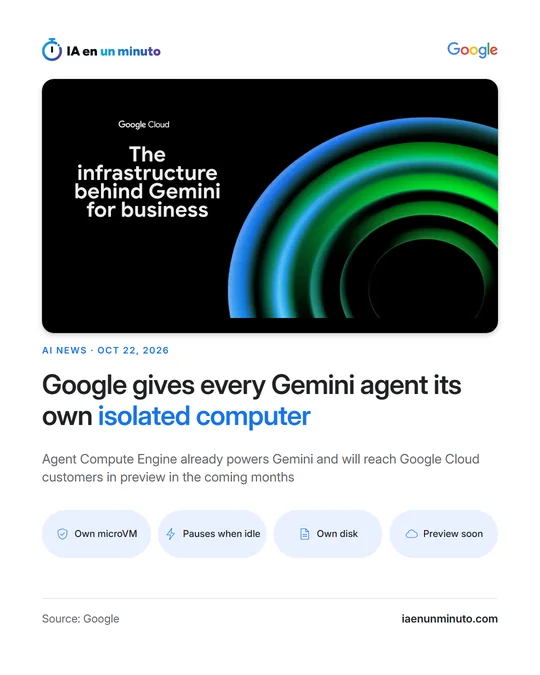
Google Cloud has launched Agent Compute Engine, the infrastructure Gemini already relies on when acting as an agent, and it will reach customers in preview within a few months. Each agent gets its own hardware-isolated microVM, which is paused while it waits and keeps its work on a disk of its own. Google is also releasing Agent Substrate, an open-source version for Kubernetes.
Google Cloud on Thursday introduced Agent Compute Engine at the AGNTCon + MCPCon conference. It is the compute service Gemini already runs on when it works as an agent (an AI that carries out tasks on its own: it writes and runs code, uses tools or drives a browser). Google Cloud customers will be able to try it in preview in the coming months and also use it with their own agents. Google has not given a price or a more specific date.
The idea is for every Gemini agent to have its own secure computer to act on. That computer is a microVM (a small virtual machine that boots very quickly), isolated by hardware, with its own operating system kernel and administrator access. Google also protects it with Titanium, the processor it dedicates to infrastructure tasks. Each microVM has its own verified identity and short-lived credentials, and service credentials are added on the way out, outside the microVM.
To make it pay off, several agents share the memory of a single operating system template, and the microVM is paused while the agent is "thinking" or waiting for a person or another system; it is then quickly resumed from a saved copy. Each one also has its own disk, to keep the agent's work and context between sessions, and it can use company data without moving it, under the same identity and security model.
Google is also presenting Agent Substrate, an open-source system that brings the same idea to Kubernetes (a platform for managing applications in the cloud) and that can already be tried on GKE, Google Cloud's Kubernetes service. It works on any Kubernetes cluster and with any agent tool, such as Claude Code, OpenClaw or Hermes. When an agent goes idle, it saves a copy of its memory and frees the machine until it is needed again. According to Google, it reaches up to ten times the compute density of traditional computing. In a Google test with 200,000 agents, it handled 500 activations per second and took less than 500 milliseconds to pause and resume each agent. The AI team Nous Research already uses it to deploy agents on the infrastructure its customers already have.
Google is also expanding its tools for controlling company agents, with a central registry of approved agents and a unique identity for each agent. That control will soon reach, in preview, multicloud or mixed environments and the coding agents that run on company-managed computers, such as Claude Code and Antigravity CLI. This quarter, also in preview, it will add limits on token spending and rules that send each request to the right model.
Why it matters · analysis and opinion
Until now, agents that run code or drive a browser have relied on infrastructure designed for other workloads, which Google itself admits was not optimized for them. It is now turning the same piece it uses with Gemini into a product, acknowledging that the challenge with agents is no longer just the model, but also where they run and with what permissions. The open version for Kubernetes lowers the risk of being locked into one provider, and its support for rival tools such as Claude Code points the same way. What would settle a purchase is still missing: the price and a firm date for the preview. Until then, a company already testing agents should review which credentials it gives them and whether it knows how many it has running.
Official source: Google Cloud · Written with the help of AI: how we make the news