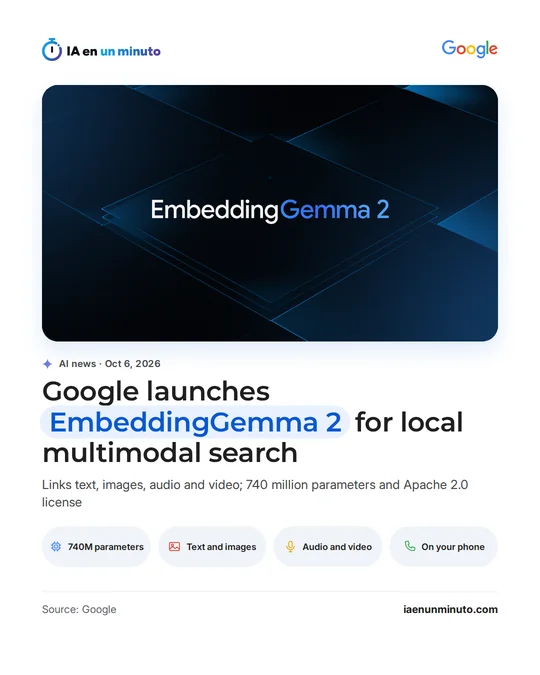
Google launches EmbeddingGemma 2, an open model that connects text, images, audio and video on the device itself
In 30 seconds
EmbeddingGemma 2 is Google's new open model for search that no longer stops at words: it places text, images, video, audio and code in a single vector space. With 740 million parameters, it builds on Gemma 4, and its Apache 2.0 license lets companies use it in commercial products. It can be downloaded from Hugging Face and Kaggle, with Model Garden to follow.
Google is taking its model for searching information on the device itself beyond text.
It has launched EmbeddingGemma 2, an open embedding model (it turns content into vectors so it can be searched and connected) that brings text, code, images, audio and video together in a shared space. It has 740 million parameters, is built on the Gemma 4 architecture (Google's generative model) and is released under the Apache 2.0 license, which allows commercial use.
According to Google, it can help find a video clip from a voice memo or search through hours of audio recordings with a text query. The new model is already available on Hugging Face and Kaggle (model platforms), and it is coming soon to Model Garden, Google's model catalog for businesses.
We think this points to a more local and private AI, without sending our files to the cloud.
Why it matters · analysis and opinion
Embedding models are the piece that lets a search engine or an assistant find what matters among many files, and Google's version worked only with text. With EmbeddingGemma 2 that search reaches images, audio and video, through an open model that runs on the device itself. It matters to developers and to companies that keep recordings, meetings, product photos or training videos and want to find them with a simple sentence. Since the Apache 2.0 license allows commercial use, a small business can try it without paying for licenses by downloading it from Hugging Face or Kaggle. In our view, it is most interesting for anyone handling sensitive data: searching without sending files to the cloud reduces risk, although it is worth testing its accuracy on your own material first.
Official source: Google · Written with the help of AI: how we make the news