IA en un minutoNewsBusiness and products
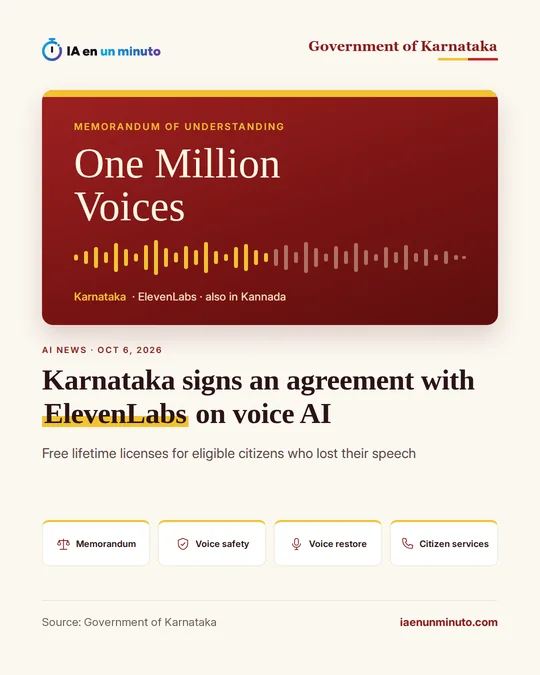
Karnataka signs an agreement with ElevenLabs to explore voice AI in public services and restore speech
IA en un minuto newsroom · Editor: Jon Elgezabal
In 30 seconds
The Indian state of Karnataka and ElevenLabs have signed an MoU to try voice AI on public phone lines and other government services. ElevenLabs will hand free lifetime access to One Million Voices to people who can no longer speak, such as oral or throat cancer patients, who will talk through a synthetic copy of their own voice. The deal also sets up a safety framework against deepfakes and voice cloning without consent.
Karnataka wants voice AI to help people who have lost their speech.
On Tuesday, the government of the Indian state signed a memorandum of understanding (MoU) with ElevenLabs, a global voice AI company. The deal rests on three pillars. One is a safety framework for voice AI, which will examine safeguards such as detecting deepfakes, watermarking and consent for cloning a voice. Another is voice restoration for people who cannot speak. The third is to explore voice AI for citizen helplines and public services.
ElevenLabs will grant eligible citizens, people with oral or throat cancer for example, free lifetime licenses for One Million Voices, its voice restoration program. A synthetic version of each person's own voice will let them communicate, in Kannada too. The pilot projects have yet to be defined.
The memorandum was signed via the Karnataka Innovation and Technology Society (KITS), which comes under the state's Department of Electronics, Information Technology and Biotechnology. The safety framework will not be tied to any one platform. It will also look at limits on cloning public figures, at protection against voice fraud and at shielding government representatives and institutions from unauthorized cloning, and it will include training for officials.
Beyond oral and throat cancer, voice restoration will also serve people whose speech has been lost to other neurological or degenerative conditions. KITS is already working with the All India Institute of Speech and Hearing (AIISH) in Mysore on how to roll out the initiative and find the people who would benefit. For public services, the agreement will explore helplines, the handling of grievances and voice interfaces in Kannada and the state's other languages. Priyank Kharge, Karnataka's IT minister, said that AI is ultimately measured by the difference it makes in people's lives.
Why it matters · analysis and opinion
A memorandum of understanding commits to almost nothing: it sets out intentions and leaves the details for later. What is concrete, for now, is the social side, with voice restoration licenses for patients whom the government itself will help to identify. The rest, from the safety framework to the use of synthetic voices in citizen services, is still to be defined, and that is where it gets interesting: a regional government wants to set rules against voice cloning before using it itself. If that framework goes ahead, it could serve as a reference for other administrations; if it stays on paper, the company will mainly have gained a showcase.
Source: Rediff MoneyWiz · Written with the help of AI: how we make the news