Radware launches protection for the MCP servers that connect AI agents to businesses
IA en un minuto newsroom · Editor: Jon Elgezabal
In 30 seconds
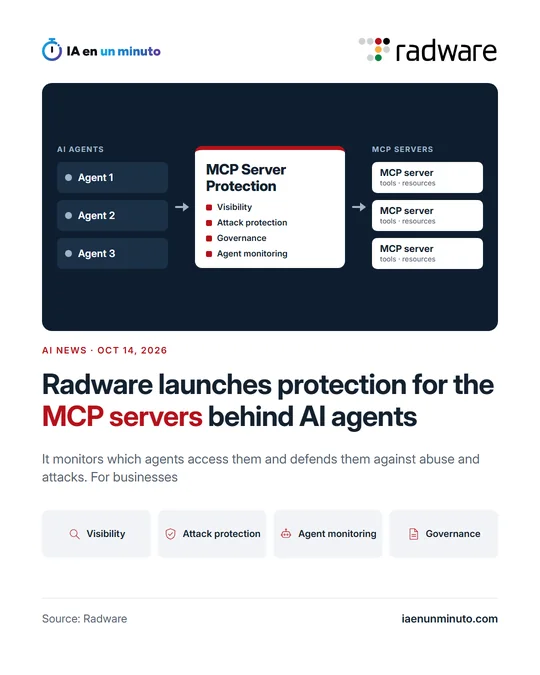
Radware is rolling out MCP Server Protection, a service that watches over and defends MCP servers, the bridge AI agents use to reach a company's systems. It reveals which servers exist, what they offer and which agents use them, and shields them from protocol abuse, unwanted access and attacks meant to knock them offline. It runs from the cloud or alongside Radware appliances installed on site, with no price announced.
Radware, a Nasdaq-listed cybersecurity company, has unveiled MCP Server Protection, a service to secure MCP servers. MCP (Model Context Protocol) is the standard AI agents use to plug into a company's applications, data and processes, and MCP servers are the pieces that make that link.
"Every new connection also expands the attack surface," said David Aviv, Radware's chief technology officer. According to the company, the servers that join agents to internal systems can open a path for attacks that long-standing web and DDoS defenses (attacks that swamp a service with traffic) may not have been built to understand or protect. Radware points to Stacklok's State of Model Context Protocol in Software 2026 survey, under which nearly half of the software companies polled already run MCP in production, and 19% do so broadly.
The service shows which MCP servers exist across the organization, which tools and resources they expose, which agents reach them, how they use them and how they communicate. It guards them against protocol abuse, authentication attacks, scanning of their tools and resources, unauthorized interactions, AI-launched floods of tool calls and denial-of-service attacks. It also examines agents' identities, how they call tools, unusual behavior and resource use to spot malicious or abusive activity, and helps assess exposure, find weak spots and apply company policies as use grows.
It is part of Radware's cloud security platform and joins the company's two other AI protections, Agentic AI Protection and LLM Firewall, to cover agents, models and the servers that connect them. It comes as a cloud service, within Cloud Application Protection Service, or as a cloud add-on for Alteon and DefensePro appliances installed on the customer's own premises, and it supports MCP servers in public or private clouds, on Kubernetes and in on-site data centers. Radware has not given a price and will present it in a webinar on December 3, 2026, at 11:00 a.m. U.S. Eastern time.
Why it matters · analysis and opinion
Until now, the conversation about AI agent security focused on the model and on what the agent can do; this launch shifts attention to the piece in between, the connector that opens the door to internal systems. A DDoS defense vendor building a dedicated product signals that these connectors are already seen as a real target, not an experiment. For a company trying out agents, the useful step is not necessarily buying this: it starts with taking stock of which MCP servers it has running, who installed them, what data they give access to and whether anyone reviews their logs. Still unknown are the cost and how it behaves beyond the promises of a press release.
Official source: Radware · Written with the help of AI: how we make the news