MiniMax launches M3.1 Flash, a fast and low-cost model for agents
IA en un minuto newsroom · Editor: Jon Elgezabal
In 30 seconds
MiniMax has rolled out M3.1 Flash, a quick and inexpensive variant aimed at agents, coding, computer use and cybersecurity. A million input tokens costs $0.15 and a million output tokens $0.60, and the company estimates 70% savings compared with M3 on agent work. Space Bunny, which ran without a name, was in fact an early build, and its weights come out on October 23.
Chinese company MiniMax launched M3.1 Flash on Monday, the new fast and low-cost version of its AI model. According to the company, the model takes a big step forward in agent tasks (AI that does work on its own), coding, operating a computer and cybersecurity.
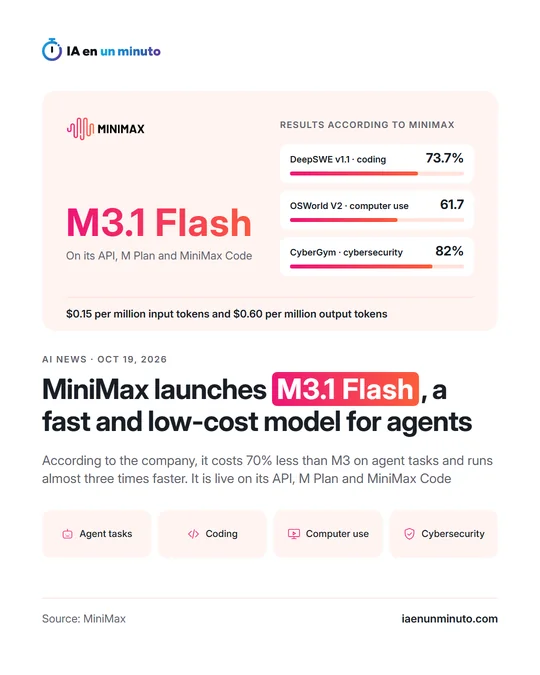
M3.1 Flash can already be used on the MiniMax API (the connection for developers), on M Plan, its subscription, and on MiniMax Code, its coding app for desktop computers. Pricing is flat: $0.15 per million input tokens (the chunks of text the model processes), $0.60 per million output tokens and $0.015 per million when the input is already stored in cache. According to MiniMax, the total cost of use on agent tasks is 70% lower than with its previous model, M3, and it responds almost three times faster. The company puts output speed above 200 tokens per second in everyday use, with a median of more than 170.
In its own tests, M3.1 Flash gets 73.7% on DeepSWE v1.1, an evaluation of complex programming tasks; 61.7 points on OSWorld V2, which measures how it operates a computer and moves from one application to another; and 82% on CyberGym, focused on finding and validating vulnerabilities. It also scores 76.2 on BankerToolBench and 29.6 points on Agents' Last Exam, a test based on real professional work; on the latter and on OSWorld V2, MiniMax says it comes first among Chinese models. These are evaluations run by the company itself.
MiniMax also confirmed that Space Bunny, a model that ran anonymously and handled more than 200 trillion tokens, was an early build of M3.1 Flash. The model weights (the files needed to install it on in-house equipment) will arrive on October 23, according to its post on X; the company's blog only says they will be published at a later point. MiniMax is also announcing a Pro version, which will come afterwards and still has no date.
The announcement does not give the model's number of parameters.
Why it matters · analysis and opinion
What matters here is not another gain on a benchmark table, but the price per task. Agents chain many steps and each one consumes text, so a small, cheap model can decide whether automating a process pays off or not. Releasing the weights will also make it possible to install it on in-house equipment, which appeals to anyone who prefers not to send their data outside. The usual gap remains: someone outside the company has to confirm those results on real work, and it is still unclear how big the model is and what hardware it takes to run it. For a team that already uses agents, it makes sense to try it on one specific task and compare cost and errors before switching providers.
Official source: MiniMax · Written with the help of AI: how we make the news