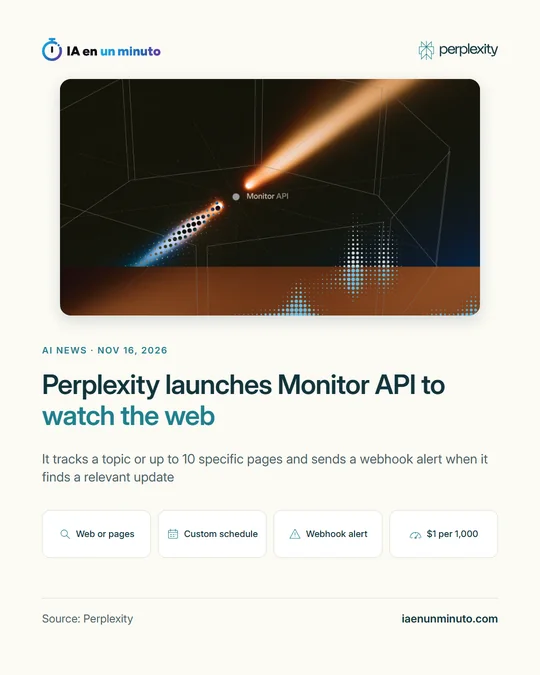
Perplexity launches Monitor API, an API that watches the web and sends an alert when something changes
IA en un minuto newsroom · Editor: Jon Elgezabal
In 30 seconds
Perplexity has a new service that scans the internet on a timetable and triggers a webhook only when something matches the goal that was set. Monitor API works in two ways: following a subject across search and news, or comparing up to 10 addresses against a stored copy. Decider, the in-house filter, scores each finding before it is sent, and every 1,000 runs come to $1.
Perplexity on Monday, November 16, introduced Monitor API, a service for developers that checks the web on a schedule and fires a webhook when it comes across a relevant update. The company pitches it as a replacement for what most teams do now: running periodic searches and keeping their own code to strip duplicates and spot changes, which becomes hard to sustain once hundreds of topics and pages are involved. Among the uses it cites are alerting a sales agent when an account announces funding, following a regulator's announcements and keeping an eye on a competitor's prices.
Each monitor is set up in plain language, with a search query or a list of pages and, optionally, a goal. There are two modes. The web mode follows a topic, a company or a question and sends the query through Perplexity Search, covering both news and web results. The page mode watches as many as 10 specific addresses, for example a changelog, a policy page or a price list: the first check stores a baseline, and later ones return the text that has changed.
The filtering is done by Perplexity Decider, which compares each result with the stated goal. For web monitors a result has to clear four tests: freshness, new information, relevance and the legitimacy of the source; for page monitors, Decider judges whether the change matters for that goal. An alert goes out only when every test reaches its threshold, which can be tuned test by test, and it carries a confidence score.
Checks can repeat weekly, daily, hourly or as often as every 15 minutes, and a custom cron schedule is also accepted; the service removes duplicates from one run to the next. Alerts arrive through signed webhooks, with automatic retries when delivery fails temporarily, and monitors can be paused, resumed or triggered on demand.
Perplexity says that in a test of its own, with 60 topics each watched for eight hours, Monitor returned the freshest and most relevant results when set against other search API providers.
It is available now through the API and the API Console, with the same key used for Search, Context and Agent API. A thousand successful runs of a web monitor cost $1, and page monitors are billed $1 for every 1,000 URLs they fetch, since one run can open many pages.
Why it matters · analysis and opinion
Until now, finding out that a competitor had touched its rates or that an API had changed meant setting up scheduled searches and writing the code that separates what is new from what is repeated. Perplexity offers that plumbing as a service and charges by use, which puts it within reach of small teams building agents: sales reacting to a funding round, compliance following a regulator, product keeping watch on rivals. The delicate part is the filter. Letting a system decide what is relevant and which source is legitimate cuts noise, but it can also stay silent about what mattered, and the only published comparison comes from the company itself. The prudent course is to start with a few monitors, review for some weeks which alerts arrive and which are missing, and adjust the thresholds before wiring up automatic actions.
Official source: Perplexity · Written with the help of AI: how we make the news