IA en un minutoNewsBusiness and products
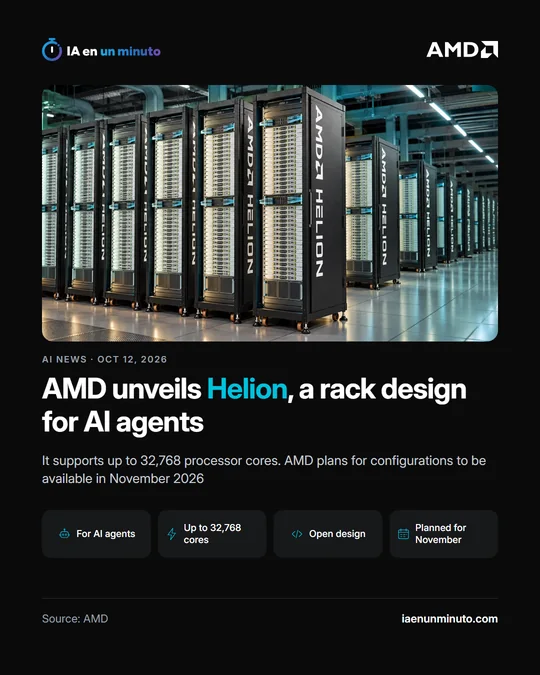
AMD unveils Helion, a rack design with up to 32,768 cores built for AI agents
IA en un minuto newsroom · Editor: Jon Elgezabal
In 30 seconds
AMD wants data centers to have a server cabinet tailored to AI agents, and to that end it has introduced Helion, an open design. The version with only EPYC processors tops out at 32,768 cores, and the enterprise one adds Instinct MI350P graphics chips. It is not on sale yet: the company is aiming for November 2026 and has not shared prices.
AMD has unveiled Helion, an open rack design built for AI agents, the programs that carry out tasks on their own. A rack is the cabinet that holds the servers in a data center. The company presented it on Monday, October 12, at the OCP Global Summit, held in San Jose, Data Center Dynamics reports. It cannot be bought yet: AMD is still developing the configurations with its partners and expects to have them available in November 2026.
Dan McNamara, a senior vice president at AMD, argues in the press release that agent-based AI is not one workload but several: personal agents, business applications, code execution and complex workflows, and each of them needs a different kind of computing. With Helion, a customer can adjust core count, performance and power draw to whatever its agents do.
AMD gives two examples. One is a rack fitted only with sixth-generation EPYC processors, AMD's server chips, with room for as many as 32,768 cores. It targets the largest data center operators: its job is to run the agents, while the models run on separate infrastructure it connects to. Tom's Hardware puts the math at 128 EPYC 9996 processors with 256 cores each.
The other is an all-in-one rack for businesses that brings together EPYC processors, Instinct MI350P graphics chips and general-purpose servers. The product page says it takes up to 16 of those graphics chips, split across two servers of eight, and that it distributes the agents' queries between advanced models in the cloud and open models hosted in the rack itself. The same page specifies that this version is not meant for training frontier models.
Helion follows the open approach of Helios, AMD's rack for training models and serving them at large scale. It is based on specifications from the Open Compute Project (OCP), the initiative that publishes open designs for data center equipment, and AMD intends to hand the Helion specification over to it. There will be liquid-cooled and air-cooled versions.
According to Tom's Hardware, AMD will not sell the racks: Helion is a reference design that manufacturers will take to market. The same outlet reports that the company first talked about the first half of 2027 and later moved the date to November 2026. Backing the design in the announcement are Cisco, Dell, HPE, Lenovo, Supermicro, Hon Hai (Foxconn), QCT and Wiwynn. AMD's press release gives no prices.
Why it matters · analysis and opinion
The conversation about AI infrastructure has almost always revolved around graphics chips. Helion points at another part of the job: when an agent runs code, queries a database or chains steps together, much of the load falls on conventional processors, and AMD wants that to be bought as a whole rack rather than as loose servers. The open design is the other half of the bet, because it leaves manufacturing in the hands of brands that companies already have as suppliers. For a mid-sized organization, the relevant part is the all-in-one version, which makes it possible to keep agents and open models in-house without setting up two installations. Prices, real power consumption and actual availability are still missing, so today it is something to ask the usual supplier about, not something to budget for.
Official source: AMD · Written with the help of AI: how we make the news