IA en un minutoNewsBusiness and products
Microsoft unveils Maia 300, its third in-house AI chip, and will make Maia its primary inference system
IA en un minuto newsroom · Editor: Jon Elgezabal
In 30 seconds
Microsoft is turning Maia, the AI chips it designs itself, into the main inference platform for its services, with multi-gigawatt deployments from 2027. Maia 300, third generation of that family, goes into production that year, and the company projects that each megawatt will yield 40% more tokens than top GPU systems. The earlier Maia 200 already serves Microsoft Copilot and is due on GitHub Copilot before the year is out.
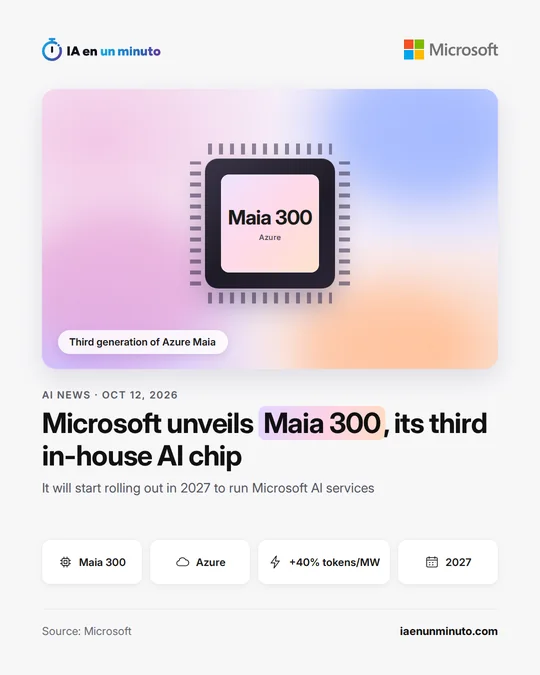
Microsoft has announced that Maia, its family of in-house AI chips, will be the "primary inference system" (the one that runs models that have already been trained) for its products and services. To get there, it will scale up Maia to multi-gigawatt deployments starting in 2027. It has also unveiled Maia 300, the third generation of the family, which will begin production deployments that same year.
According to Scott Guthrie, executive vice president of Cloud + AI at Microsoft, who signs the announcement, the company expects Maia 300 to deliver 40% more tokens (the units of text that AI processes) per megawatt than leading GPU-based systems. In its full configuration, with 96 accelerators in a single server rack, it reaches up to 7 times the token throughput of a Maia 200 rack. It is designed for long-context reasoning, for conversations where response speed matters and for multi-step tasks carried out by AI agents.
The previous generation, Maia 200, was announced in January and is already running in services such as Microsoft Copilot, the company's AI assistant. It will reach GitHub Copilot, the coding assistant, and Microsoft Foundry by the end of the year. It is being deployed across the United States, Europe and Australia, and it runs OpenAI models, Microsoft's own MAI models and open-source model families. Microsoft credits it with up to 1.7 times more tokens per watt than leading GPU infrastructure for the AI features built into Teams, Copilot and Cowork.
On the technical side, Maia 300 splits the work across several chiplets (separate pieces of silicon for compute, memory control and input and output), and the compute chiplets are built on TSMC's N2P process. Each accelerator carries eight HBM4 memory stacks within a thermal design power of 950 watts; a full rack stays within 167 kilowatts. According to the technical overview published by Azure, that amounts to 2.5 times the memory bandwidth of Maia 200 and 33% more capacity.
The announcement gives no prices, does not say which regions will get Maia 300 and does not name the makers of the GPUs it is compared with. The Verge, which covers the announcement, presents it as a chip that makes Microsoft less reliant on Nvidia's GPUs. Microsoft says it will share more information about its strategy next month at Ignite 2026, its conference in San Francisco.
Why it matters · analysis and opinion
The real story is not the chip but the change of role. Until now, Microsoft's own processors sat alongside GPUs as one more piece of its infrastructure; the announcement puts them at the center of how its models are run. The reason lies in the unit it chooses to measure itself by: tokens per megawatt. When what limits a datacenter is electrical power and cooling, whoever gets more answers out of the same energy can serve more users without building more. For a company that uses Copilot or buys models on Azure, nothing changes overnight: the large rollout starts next year and Microsoft says nothing about prices. Also missing is a comparison with names and measured by third parties, because the figures are the manufacturer's own projections against rivals it does not identify.
Official source: Microsoft · Written with the help of AI: how we make the news