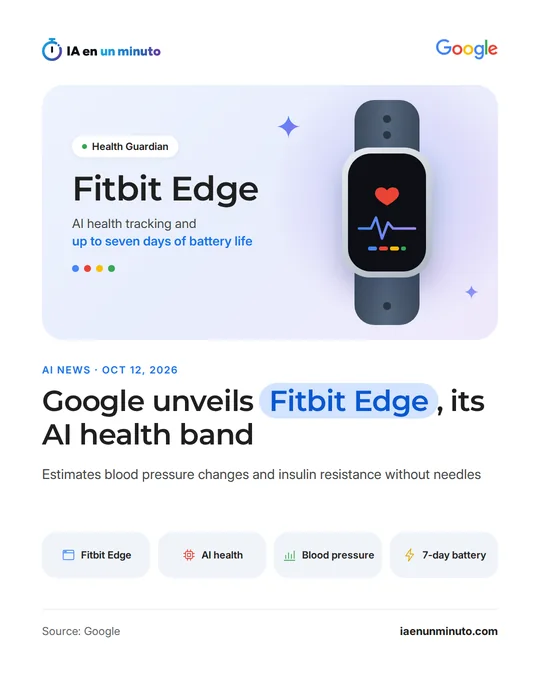
Google unveils Fitbit Edge, an AI health band with up to seven days of battery life
IA en un minuto newsroom · Editor: Jon Elgezabal
In 30 seconds
Fitbit Edge, Google's new fitness band, runs for up to seven days between charges and costs $179.99, going on sale on October 27. Health Guardian will follow how blood pressure and insulin resistance evolve on it and on Fitbit Air, with no diagnostic value and only with Google Health Premium. Google has also agreed with Flo Health to sync menstrual cycle data from early next year.
Google is bringing AI-powered health tracking to a new fitness band.
On Monday, the company unveiled Fitbit Edge, a fitness tracker that, according to Google, sits between an advanced smartwatch such as Pixel Watch and a simple, screenless band such as Fitbit Air. Its battery lasts up to seven days on a single charge. It is available for pre-order now for $179.99 on the Google Store and through retail partners, will reach stores on October 27 and comes with three months of Google Health Premium. There is also a special edition created with Stephen Curry, the four-time NBA champion, for $219.99.
The band has a Hybrid OLED display with 46% more viewing area than previous Fitbit trackers, is 11.5 millimeters thick and includes GPS, an ECG app and a skin temperature sensor. It automatically recognizes up to 100 types of workout, is water-resistant to 50 meters and, according to Google, is its first repairable fitness tracker, with a replaceable battery. Five minutes of charging give a full day of battery when the battery is low.
In addition, Health Guardian, its new suite of health and safety tools, will arrive later this month on this band and on Fitbit Air. It will require a paid Google Health Premium subscription, and availability varies by country and device.
These features track blood pressure trends and insulin resistance trends in the background and send alerts for a high or low heart rate. Those who meet the monthly wear requirements will get a report at the beginning of each month. As the company explained on a call with the media reported by Expansión, the insulin resistance estimate does not rely on needles or on external continuous glucose monitors: it is calculated with the device's own sensors and AI models. Google notes that they are general wellness features and are not intended to diagnose, treat, cure, or prevent any medical condition. They are not a prescreener for diabetes or hypertension either, do not provide real-time clinical readings and should not be used to adjust medications.
Google has also announced a multi-year strategic partnership with Flo Health, the menstrual cycle tracking app, which according to the announcement is used by more than 80 million women every month. Starting early next year, it will be possible to sync the Flo app with Google Health: with each user's consent, her cycle data will be linked with metrics such as resting heart rate, skin temperature and sleep stages. No data will move between the apps without explicit permission, which is given separately for each type of data and each purpose and can be withdrawn at any time. Google adds that Flo data will not be used for advertising or sold. The two companies also plan to carry out research on women's health together, on topics that may include perimenopause, pregnancy and postpartum recovery.
The announcements give the price only in dollars and do not list the countries where Health Guardian will be available.
Why it matters · analysis and opinion
The striking part is not the band but what it promises to estimate. Tracking insulin resistance without needles or external glucose sensors, using only what a wrist device already carries, is a long way from counting steps or heartbeats. The fine print weighs as much as the announcement: these are wellness features, they are not a screening tool and should not be used to adjust medication, they require a paid subscription and they will not reach every country. The announcements do not give accuracy figures for those estimates either. The agreement with Flo points the same way: whoever gathers more health data in a single app will be able to give more personal advice. That is why the separate permission for each type of data is the part to read carefully before accepting.
Official source: Google · Written with the help of AI: how we make the news