White House restores UK access to test AI models before launch, The Telegraph reports
IA en un minuto newsroom · Editor: Jon Elgezabal
In 30 seconds
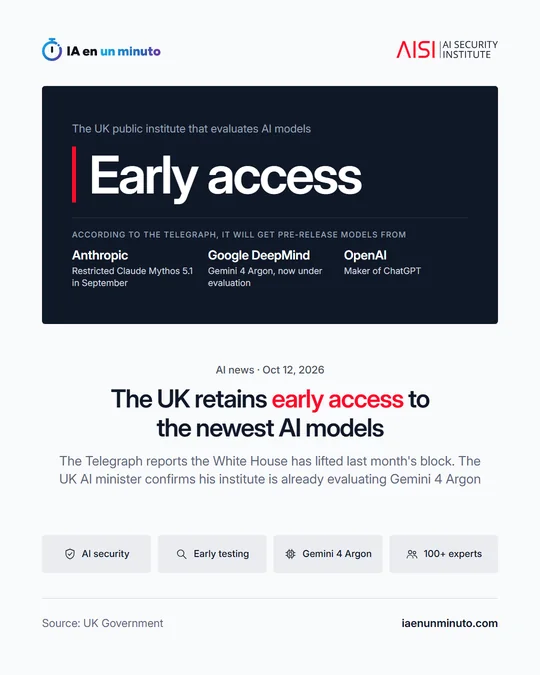
The British AI Security Institute keeps receiving leading AI systems before they go public and is already examining Gemini 4 Argon, minister Kanishka Narayan confirmed in London. The Telegraph says the White House lifted the restriction that had led Anthropic to limit the review of Claude Mythos 5.1. Narayan urged the labs not to ship a system whose risks they are unable to control.
Britain's public institute for examining AI once again has the most powerful models before they reach the market.
The United Kingdom is keeping its access to the most powerful AI models ahead of launch so that it can put them through safety tests. Kanishka Narayan, the UK's AI minister, confirmed it on Monday, October 12, in a speech at Imperial College London. He said scientists at the AI Security Institute (the British public body that assesses the risks of these systems) are already evaluating the newest generation of models, Google's Gemini 4 Argon among them.
On Sunday, October 11, The Telegraph had reported (article republished by AOL) that the White House has given the institute that access back following efforts by British ministers. According to the newspaper, the instruction to stop sharing models came from the Office of the National Cyber Director in Donald Trump's administration, and in its wake Anthropic limited the review of its new Claude Mythos 5.1. The Decoder, which summarizes the Telegraph story, dates that instruction to September and specifies that the institute will again receive models from OpenAI, Anthropic and Google DeepMind before they launch.
Narayan explained that over recent weeks his government has worked with Washington and with the labs to keep that access, in contacts ranging from the meeting of AI developers convened by the King at Dumfries House, in Scotland, to the UN General Assembly in New York. He described the institute as a team of more than a hundred technical experts.
He also said that, in two British government pilot projects, the most advanced AI has helped find and fix more than a thousand vulnerabilities, along with other threats to public services, and that the central vulnerability-monitoring service has helped cut the time needed to repair detected weaknesses from 50 days to eight. He added that the institute will play a significant part in setting a shared view of technical standards.
As for the companies building these systems, he asked them to listen to their scientists when they warn of serious dangers, to look into unexpected behaviour and, if they cannot control the risks adequately, not to release the system.
Why it matters · analysis and opinion
A government being able to examine a model before it reaches the public is one of the few outside checks that exist on the most powerful systems, and this episode shows how fragile it is. From what has been published, it depends on the labs being willing to share and on Washington allowing it: one instruction was enough for a company to shut the door on the British institute. Access is back, but by the same route through which it went away, political negotiation. Anyone relying on those evaluations as a guarantee would do well not to treat them as permanent. It remains to be seen whether London turns access into an obligation or keeps depending on the goodwill of the companies and the White House, and whether Narayan's warning to the labs moves from words to a rule.
Official source: GOV.UK · Written with the help of AI: how we make the news