GoDaddy, Google and Cloudflare unveil a transaction system for AI agents
IA en un minuto newsroom · Editor: Jon Elgezabal
In 30 seconds
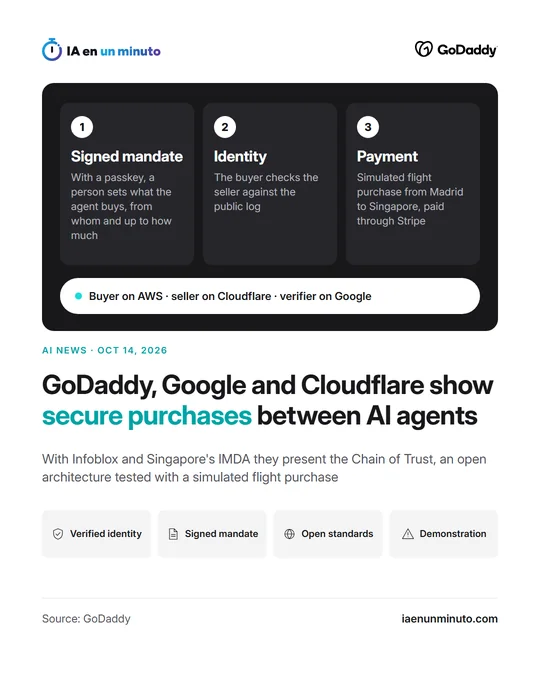
GoDaddy, Infoblox, Google and Cloudflare showed in Singapore a plane ticket bought from start to finish by AI agents hosted on different clouds. A person authorized the spending with their passkey, each agent had to prove who it was before moving on, and the fraud attempts were halted before any payment. The Chain of Trust is still an open prototype, built on DNS, A2A and AP2, now offered to registrars, payment networks and regulators.
GoDaddy, Infoblox, Google and Cloudflare have shown how AI agents from different companies can complete a purchase while verifying their identity at each step.
They presented it at GovWare 2026, part of Singapore International Cyber Week. It is called the Chain of Trust and it is an open reference architecture, a model that any organization can adopt, developed with IMDA, Singapore's media and infocomm authority, on the principles of its governance framework for agentic AI (version 1.5).
According to the announcement, most platforms today check agents each on their own and with closed systems, leaving a company with little insight into the way an agent was identified or into whether it deserves trust. The proposal is that anyone can carry out that check at each step, from locating the agent to payment and audit, and that no single platform decides by itself which agents business can be done with.
The demonstration simulated buying a flight from Madrid to Singapore between agents that had never met and were not on the same platform: the buying agent ran on Amazon Web Services, the selling one on Cloudflare Workers and the verifying one on Google. A person approved the purchase with a passkey, and an independent service set out in a signed mandate which purchases the agent was allowed to make, with which seller and with which spending cap. The buyer found the seller through DNS, checked its identity in the public log, and the approval service confirmed that its trust score reached the minimum the person had asked for. Payment went through Stripe.
The test included a seller impersonating another one and forged credentials, and the system stopped every case before a purchase took place. Each step, from discovery to payment, is kept in a public log that data can only be added to, so any later change shows.
It all relies on open standards the internet already uses, such as DNS (the system that translates website names), and on agent protocols such as A2A (so agents can talk to one another) and AP2 (the agent payments protocol). "We don't need to rebuild the internet for AI agents," said Jared Sine, GoDaddy's chief strategy and legal officer.
It was a demonstration of a prototype, not a product that can be used yet. The companies want regulators, payment networks, cloud and AI platforms, identity providers, registrars of domain names and the operators of DNS to take it up and build on it. The technical paper describing the prototype is published at openagentcommerce.org, where organizations can also register to publish their own agents under this architecture. McKinsey estimates that AI agents could handle between $3 trillion and $5 trillion in consumer purchases worldwide by 2030.
Why it matters · analysis and opinion
What stands out is not the simulated purchase but who is behind it: the largest domain registrar, a networking company, Google and Cloudflare are proposing that agent identity rest on open pieces of the internet rather than on each platform's closed system. It is the alternative to every store or payment gateway deciding on its own which agents to trust. Moving from prototype to real use needs nearly everyone else: payment networks, merchants, agent platforms and regulators willing to accept that log as proof. Anyone who sells online would do well to follow protocols such as AP2 or A2A, because they will shape how orders placed by agents reach them.
Official source: GoDaddy · Written with the help of AI: how we make the news