Google DeepMind uses its Antigravity agent platform to search for new antimicrobial peptides
IA en un minuto newsroom · Editor: Jon Elgezabal
In 30 seconds
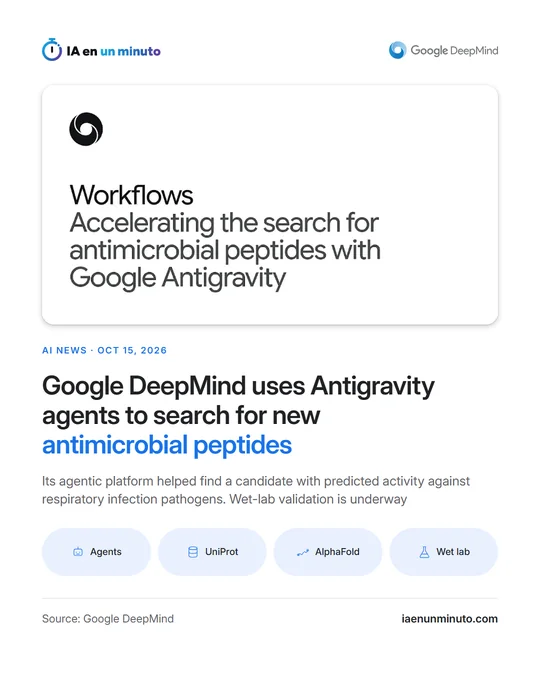
Google DeepMind has shown how biologists, helped by an Antigravity agent, combed through UniProt in search of new antimicrobials. The agent cross-checked databases, studied the 3D shape of proteins and went through the literature, while the researcher set the course. The candidate they found, aimed at respiratory pathogens, is now in lab testing.
Google DeepMind described on Thursday, October 15, how a team of biologists used Google Antigravity, its development platform built around AI agents, to locate a possible antimicrobial peptide among the millions of proteins with no known function held in UniProt, the large public database of protein sequences. According to the predictions, the candidate would act against pathogens involved in respiratory infections. It is now being tested in the lab, along with others that came out of the same process.
The company frames the work around the problem of antimicrobial resistance, which, according to an estimate it cites, could cause around 10 million deaths a year worldwide by 2050. Antimicrobial peptides, especially bacteriocins, are seen as an alternative to classic antibiotics: they strike at weak points in other bacteria, and pathogens find it harder to become resistant to them. Many remain hidden in databases because they do not resemble any protein already studied.
To read those sequences, Google developed ProtNLM, a model that works out what a protein does from its chain of amino acids and has already added descriptions to millions of UniProt entries that had no name.
In the session DeepMind describes, the researcher set the goal, looking for new peptides in the bacterium Streptococcus pseudopneumoniae, and decided what to ask at each step; the agent did the heavy lifting. It filtered the database down to a bacteriocin 97 amino acids long and checked with the BLAST tool that it did not resemble any manually reviewed protein. It then retrieved its 3D shape from the AlphaFold database, the Google DeepMind system that predicts protein structures, and compared it with structures measured in experiments: it closely resembles that of a known bacteriocin. It also examined the neighboring genes, which point to a complete bacteriocin system, and went through the scientific literature, from which it inferred that the peptide could target cell division in several drug-resistant bacteria. Finally, it drew up the lab testing plan, which includes producing the protein and running activity and toxicity assays.
Alongside the post, Google is adding a 3D structure viewer to Antigravity, the Biomolecular Structure Viewer, shared by the agent and the scientist: the scientist can mark a region of the protein and ask about it directly. DeepMind stresses that the candidate is a plausible lead, but that only the lab will tell whether it works, and it gives no timeline or results for those tests.
Why it matters · analysis and opinion
What is new is not that an AI proposes molecules, but that a single session replaces days of scripts, file exports and scattered tools, with the scientist in charge of every question. For a small lab, that makes the first filter cheaper, and that is exactly where most time is lost. The showcase has clear limits: it is a walkthrough chosen by Google itself to present its product, the candidate exists only in predictions for now and DeepMind has not yet published any experimental result. Until the activity and toxicity tests come in, what has been shown is that the agent organizes the evidence well, not that it finds drugs. The thing to watch is whether other groups, outside Google, reproduce the method with their own pathogens.
Official source: Google DeepMind · Written with the help of AI: how we make the news