NVIDIA details the rollout of AI agents for urban operations in EMEA
IA en un minuto newsroom · Editor: Jon Elgezabal
In 30 seconds
NVIDIA has used its blog to run through the projects in European cities that rely on its AI agents and digital twins to manage buildings, ports and public services. In Côte-d'Or, where they cover more than 500 public buildings, the company credits them with a 10% cut in costs and aims for 30% as the system grows. Milan, Antwerp-Bruges, Gothenburg and Liverpool have other projects under way or being studied.
NVIDIA has explained on its blog, in a post dated Tuesday, October 13, how a number of cities and public bodies in Europe, the Middle East and Africa (the region the company calls EMEA) are using its technology to create AI agents (programs that analyze data and act on their own) and digital twins (virtual copies of buildings or cities). According to the company, these applications help anticipate maintenance, guide urban planning and speed up public services, and there are projects in Belgium, Finland, France, Italy, the Netherlands, Poland, Sweden and the United Kingdom, among other countries.
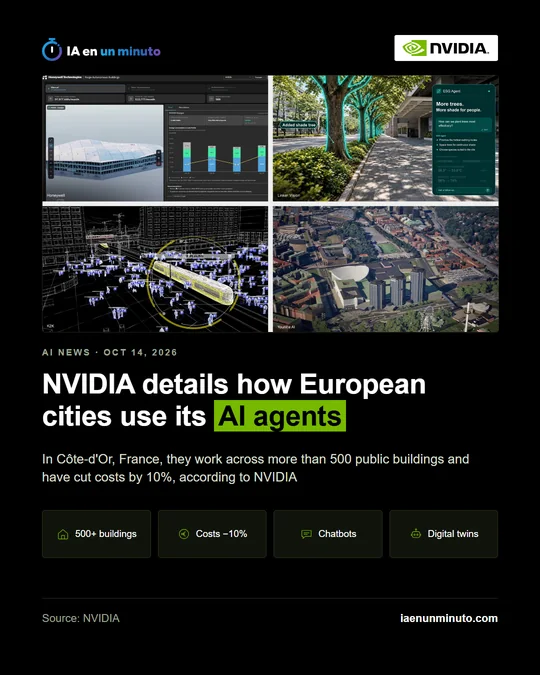
The case with the most data is that of the French department of Côte-d'Or. Together with the companies Akila and ThinkDeep, it has built agents that bring together sensor, infrastructure and historical data in a digital twin made with NVIDIA's Nemotron models and Omniverse libraries. They work across more than 500 public buildings and help with energy, regulatory compliance, safety and adapting to the climate. According to NVIDIA, finding documents now takes minutes instead of weeks, and total running costs have fallen by 10%, with the aim of reaching 30% once it is scaled up. Also in France, the Sud de France port in Sète uses ThinkDeep's agent platform to analyze cargo and safety data and to guide how dangerous goods are handled.
In the Milan region, Galene.AI, Dell Technologies and TD Synnex are setting up an "AI factory" (a computing center for AI) run locally. It begins in Cinisello Balsamo and is due to reach four more towns, offering live translation, chatbots for residents and help with public tenders and funding. The goal, according to NVIDIA, is to lighten administrative work and let residents look up municipal data in seconds rather than hours, with the data managed locally.
At the Port of Antwerp-Bruges in Belgium, Milestone and Dell are testing whether agents that analyze video could raise the alarm over oil spills. Because there is little real data on such incidents, they train the models on synthetic (computer-generated) data. In Gothenburg, Sweden, Younite is building a digital twin with Omniverse libraries, under the European Union's Citiverse initiative, so that people heading to an event can check the entrance, the seating and the crowds before they get there. With the Liverpool City Region, the company K2K is studying how to set up AI factories for urban planning and public services, with mobility and safety tests; it also works with the Island of Jersey and is exploring a pilot project with Innovation City Belfast on mobility, transport, public safety and event management.
Outside Europe, Honeywell Technologies is rolling out its Forge Cognition system at the Fairmont hotel in Dubai to link AI agents with the building's equipment. To move from trials to everyday use, NVIDIA points to hardware makers such as Supermicro, Lenovo, HPE, Dell and Cisco, which sell equipment for building these AI factories on site, and to Accenture and EY as integrators. The post only gives results with figures for Côte-d'Or and does not mention prices.
The post is one of the announcements NVIDIA is releasing ahead of its GTC Berlin conference, running October 20 to 22, where its CEO, Jensen Huang, will speak on Wednesday the 21st. NVIDIA and its partners will also take their work with cities to the Smart City Expo World Congress in Barcelona, November 3 to 5.
Why it matters · analysis and opinion
Behind the roundup lies a clear commercial strategy: NVIDIA wants city councils and regions to set up their own computing capacity and fill it with its partners' applications, and the selling point is that residents' data stays at home. The argument sounds good, but most of the cases mentioned are still trials, studies or expansion plans, and the only results with figures come from the company itself. For a city official, the useful part lies in the most concrete uses, such as finding documents or managing energy in buildings, which can be tried on a small scale before committing a budget. What is still unknown is how much these installations cost and who maintains them once the pilot project ends.
Official source: NVIDIA · Written with the help of AI: how we make the news