NVIDIA releases Run:ai, its AI orchestration platform, under the Apache 2.0 license
IA en un minuto newsroom · Editor: Jon Elgezabal
In 30 seconds
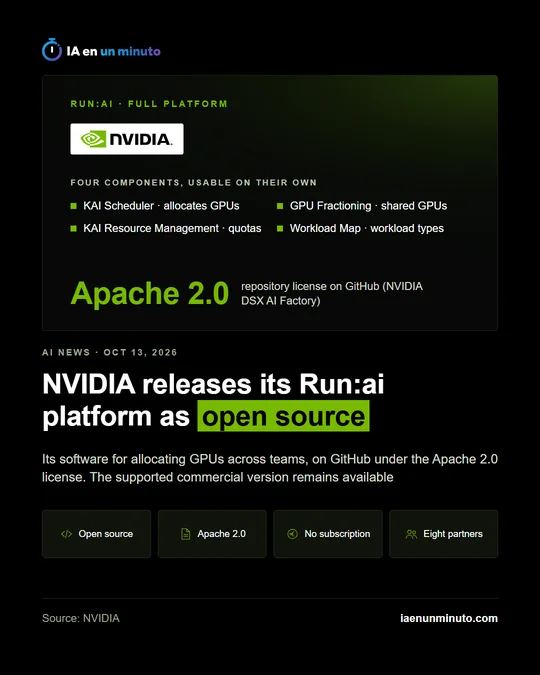
NVIDIA is opening up the code of Run:ai to everyone, the software that divides GPUs among teams sharing the same Kubernetes infrastructure. The GitHub repository carries the Apache 2.0 license, and whoever installs it from NGC pays no subscription, though they get no support either. Eight partners are already adding it to their offerings, and the paid version, backed by NVIDIA, is still sold separately.
On Tuesday, October 13, NVIDIA released the full Run:ai platform as open source. Run:ai is the company's software for organizing artificial intelligence workloads and sharing out GPUs (the chips that models are trained and run on) across infrastructure used by several teams. It runs on Kubernetes, the system that manages containerized applications. NVIDIA made the announcement on its technical blog, where it notes that Run:ai has spent several years assigning GPUs on the fly across the whole life of a project: data processing, training and inference.
The code is on GitHub, inside the NVIDIA DSX AI Factory organization, under the Apache 2.0 license, according to the repository itself. That license lets anyone use it, change it and build products on it. It can also be installed from NGC, NVIDIA's software catalog, as a community product: there is no need to pay for a Run:ai subscription, but the company's support is not part of the deal, and downloading it from there means accepting NVIDIA's software license agreement and its terms for artificial intelligence products.
The release includes four pieces that can be used separately: KAI Scheduler (the scheduler that shares out the GPUs, which was already open source), GPU Fractioning Operator (so several workloads can split a single GPU), KAI Resource Management (quotas and hierarchies by organization) and Workload Map (a common way to describe each kind of workload). Run:ai could already divide one GPU among several workloads with NVIDIA's own proprietary technology; that version has been retired, and the new piece relies on the equivalent feature built into CUDA 13.4.
Eight NVIDIA partners are already building it into their services, among them Nebius, Crusoe, Spectro Cloud, Mirantis and Rafay. The commercial version, with NVIDIA support, is still on offer as a separate product, inside NVIDIA Mission Control and NVIDIA AI Enterprise and on some cloud software marketplaces; availability, licensing and support vary from one option to another.
Why it matters · analysis and opinion
Opening up the software that decides which workload uses each chip is a move that favors whoever sells the chips. The easier it is to make good use of GPUs in any cloud, the more appealing it is to buy them, and the partners already integrating it extend NVIDIA's reach without it having to sell them a license. For teams that share GPU servers, the change is practical: they can try a mature allocation system without negotiating a subscription and without being tied to a contract. The trade-off is support: anyone who installs it on their own will have to maintain it with their own staff or pay for the commercial version. What is not yet known is how much of a community will form around the code and whether NVIDIA will keep publishing improvements in the open at the same pace as in its paid product.
Official source: NVIDIA · Written with the help of AI: how we make the news