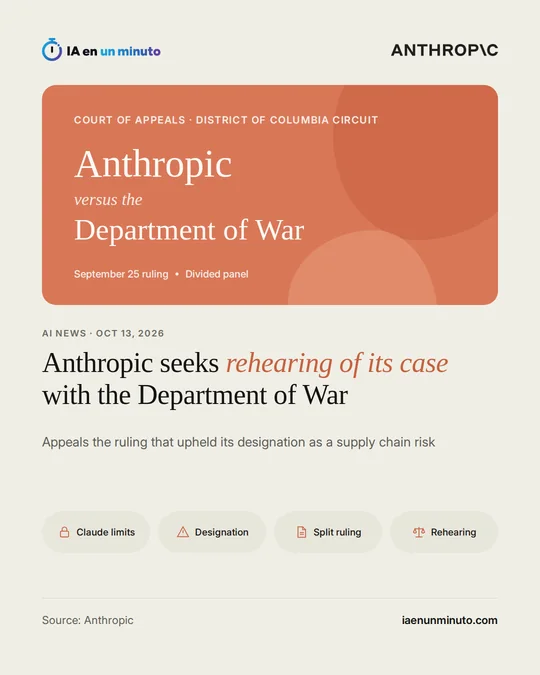
Anthropic asks the U.S. Court of Appeals for the District of Columbia Circuit to rehear its case against the Department of War
IA en un minuto newsroom · Editor: Jon Elgezabal
In 30 seconds
Anthropic wants the appeals court for the District of Columbia to revisit the September 25 ruling that, by two votes to one, upheld treating it as a supply chain risk. The clash began when it refused to let Claude serve in lethal autonomous warfare or to watch Americans en masse. The company says Hegseth gave it no chance to defend itself and leans on the dissent written by Henderson.
Anthropic is pressing ahead with its lawsuit against the U.S. Department of War (the Pentagon).
On Tuesday, October 13, the company asked the U.S. Court of Appeals for the District of Columbia Circuit to have its case looked at again by the same three judges or by the full court. In a September 25 ruling, a divided panel upheld, by two votes to one, its designation as a national security supply chain risk.
That designation came after Anthropic refused to lift the limits that kept its Claude models from being used in lethal autonomous warfare or for mass surveillance of Americans. According to the petition, the Department started using Claude in March 2025 under a usage policy written for the government. In September 2025 it demanded that the model be open to "all lawful uses", and Anthropic agreed to drop every limit except those two. On February 27, 2026, President Trump ordered every agency to stop using its technology, and the formal notice of the designation arrived on March 4.
In its petition, Anthropic disputes how the majority read the law and argues that the Secretary of War, Pete Hegseth, skipped the requirements to warn of the designation before applying it and to give the company a chance to respond. The majority did not accept the Secretary's accusation that Anthropic was a "hostile party", but found that the law reaches anyone who designs a model to limit certain uses, whatever the intent, and held that skipping those steps did not change the outcome. Anthropic also argues that the designation infringes its freedom of speech and its right to due process, and points out that a federal court in the Northern District of California, looking at a parallel designation under a different law, saw direct evidence that it was a response to the company's public statements.
It also cites the dissent by Judge Karen LeCraft Henderson, under which companies that work for the government face a choice to "agree to the Secretary's demands or risk being designated a national security threat."
The petition stresses that only the District of Columbia Circuit can hear these challenges, so if the case is not reheard, only the Supreme Court could overturn the panel's decision. Third parties have filed fifteen amicus briefs in the case. The court must now decide whether to take it up again.
Why it matters · analysis and opinion
What is at stake is no longer just one company's contract with the military, but how much leeway the government has over any supplier that puts limits on the use of its technology. If the majority's reading stands, a law that Anthropic considers aimed at hostile foreign actors could be applied to domestic companies that refuse certain uses, and that weighs on any AI company negotiating with public administrations. Usage policies, seen until now as a matter of corporate ethics, now carry a commercial risk as well. Anyone selling software to the public sector would do well to review which restrictions they include in their contracts and how they justify them in writing. It remains to be seen whether the court agrees to the new review and whether the case ends up at the Supreme Court.
Source: CourtListener · Written with the help of AI: how we make the news