Brussels proposes that its clock for fining AI systems restart with each investigative step
IA en un minuto newsroom · Editor: Jon Elgezabal
In 30 seconds
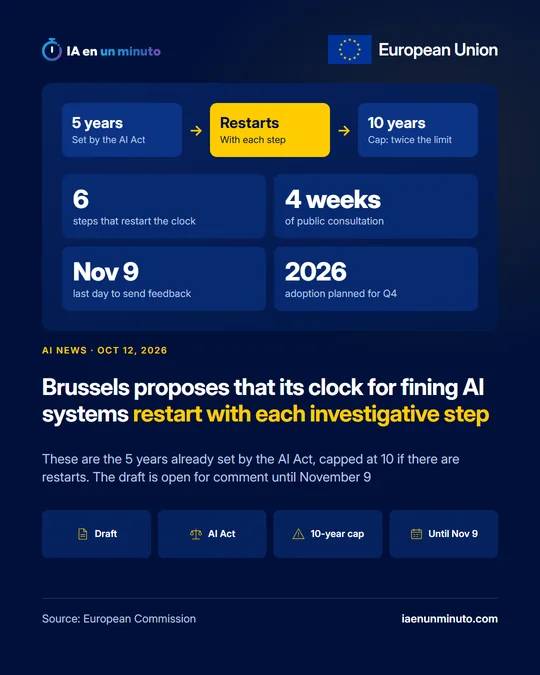
The European Commission is taking feedback until November 9 on a draft about its investigations into some AI systems. The five years it has to sanction them would begin again after each of its steps, up to a maximum of ten years, and would not run while a breach continues. The company under investigation could only consult the full file through outside advisers.
The European Commission opened a public consultation on Monday, October 12, on a draft regulation that spells out two parts of its investigations into the AI systems it supervises itself under the AI Act, the European law that regulates this technology: how the time it has to impose a fine is counted and who can see the file. Those systems are the ones built into very large online platforms and search engines (those designated under the Digital Services Act) and those based on a general-purpose AI model developed by the same company. The text does not name any company.
The five-year period for imposing a fine is not new: the draft notes that the AI Act already provides for it. What it proposes is how that period is counted. Where non-compliance is continuing or repeated, the period only starts running on the day it ends. In addition, any step the Commission takes in the investigation interrupts it and starts it again from zero. The draft lists six: requests for documentation or information, requests for access to evaluate a system, inspections, invitations to a structured dialogue, the opening of proceedings and their re-opening.
There is a cap: the period expires at the latest once twice that time, that is, ten years, has passed without the Commission imposing a fine. Any time during which the period is suspended is added to that cap, which happens while the Commission's decision is the subject of proceedings before the Court of Justice of the European Union or while an on-site inspection is awaiting judicial authorization.
The same approach applies to collection. The five years available to collect a fine, which also come from the AI Act, would start when the decision becomes final and would restart with each step taken to enforce payment.
The draft also covers access to the file, the documents the Commission gathers against the company under investigation. The company cannot see it until it receives the preliminary findings, and the full version, with nothing redacted, only goes to a limited number of external lawyers, economists and technical experts, whose names must be sent to the Commission in advance.
It is a draft. The document itself states that it has not been adopted or endorsed by the Commission and that it reflects the preliminary views of its services. Feedback can be sent until November 9, and adoption is planned for the fourth quarter of 2026.
Why it matters · analysis and opinion
The rule looks at very few companies: those with an AI system inside a platform or search engine that Europe classes as very large, or those that build the system on their own model. For them it changes how risk is calculated: with a clock that does not start while the breach lasts and that goes back to the beginning with every request for information, old conduct can stay exposed to a penalty long after it has been corrected. The way the file is shared matters too, because the party defending itself does not read all of it and depends on outside advisers. None of this is binding yet. It is a text under consultation, and anyone who uses or advertises on those platforms has a few weeks to comment before it closes.
Official source: European Commission · Written with the help of AI: how we make the news