The EU says it is well equipped to handle rogue AI agents
IA en un minuto newsroom · Editor: Jon Elgezabal
In 30 seconds
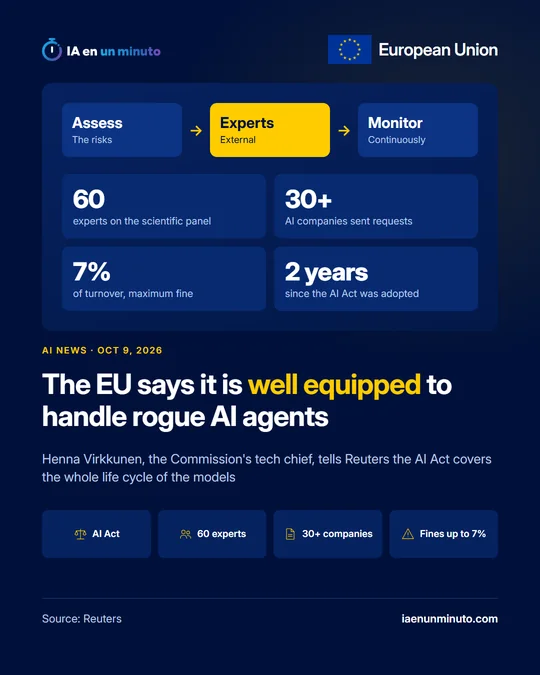
Henna Virkkunen maintains that the AI Act is enough to deal with agents acting out of control, because it spans the entire life of the models. Regulators are handing companies evaluation guidance and will listen to a panel of 60 experts. The more than 30 firms that got requests for information in August, Chinese startups included, face penalties reaching 7% of turnover.
Henna Virkkunen, the European Commission's tech chief, told Reuters, as reported by Global Banking & Finance Review, that the AI rules the bloc adopted two years ago are more than capable of tackling rogue agents.
She said it on Friday, October 9, amid mounting concerns worldwide triggered by recent incidents at OpenAI and Anthropic, which have sparked fears that rogue AI systems may slip beyond human control.
"We see that the safety and security of very capable models is a very hot topic internationally and we in Europe are well equipped for that," she said. "We have our AI Act in place and the AI Act covers the whole life cycle of these models." The AI Act regulates the use of the technology based on the level of risk and, according to Reuters, is seen as embodying the world's strictest rules on artificial intelligence.
According to Virkkunen, regulators are giving companies guidance on how to evaluate their models and how much time to allocate for it, and they would also factor in recommendations from a scientific panel of 60 AI experts from universities and institutions.
She also dismissed criticism from some companies that the rules are already outdated. In her view, legislators took the coming developments into account very well: they saw that risks have to be assessed, that external experts have to be used and that the models have to keep being monitored.
Reuters notes that the Commission sent requests for information in late August to more than 30 AI companies about their safety and security measures, and followed up with questions about their transparency and copyright obligations. Such requests can lead to investigations that could result in fines of as much as 7% of a company's global annual turnover. The Commission did not name the companies it had approached, and Virkkunen said she is now assessing the responses.
Asked about Chinese AI startups, Virkkunen confirmed that they have received requests for information as well, and added that the most capable models now on the market are from the United States and China. "I think that all these capable models, of course they are posing new kinds of risks that we have to be aware of," she said.
These are remarks from an interview, not a new measure.
Why it matters · analysis and opinion
Brussels is announcing nothing new, and that is the news: faced with the alarm over agents that slip out of control, its answer is that the law it already has is enough and that it does not consider it outdated. For those who develop models, the practical message is in the rest of the interview. Risk assessment, the use of external experts and continuous monitoring stop being good practice and become what the regulator is going to ask about, with a scientific panel behind it and requests for information already on the table. There is no geographic refuge either: Chinese companies have received the same questions as everyone else. For a company that only uses these models nothing changes yet, though it helps to know that its provider answers to the regulator throughout the life of the model. It remains to be seen whether the responses end in investigations.
Source: Global Banking & Finance Review (Reuters) · Written with the help of AI: how we make the news