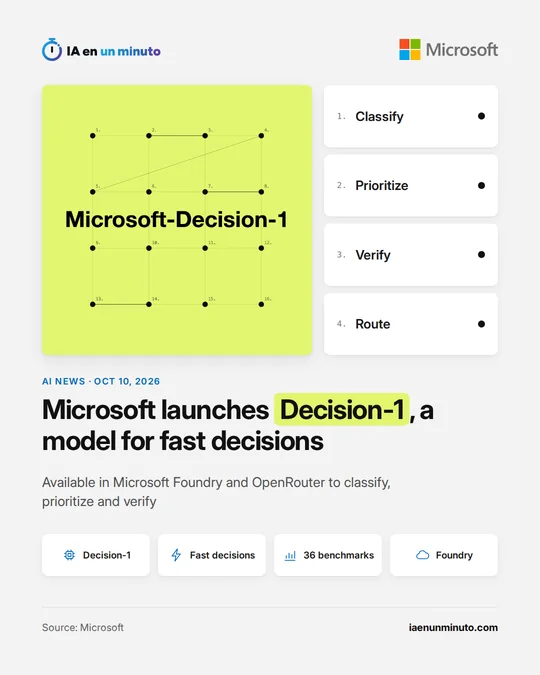
Microsoft launches Microsoft-Decision-1, an AI model for fast decisions in applications and agents
IA en un minuto newsroom · Editor: Jon Elgezabal
In 30 seconds
Microsoft-Decision-1 is a Microsoft model made to choose between options rather than write: it gives a structured result that software uses for classifying, prioritizing, verifying or routing tasks. It can be used today from Microsoft Foundry and from OpenRouter. In the company's measurements it ranked first for accuracy over 36 benchmarks and ran 35 times faster than GPT-6 Sol.
Microsoft introduced on Friday, October 9, an AI model that is not designed to generate text or reason through complex problems, but to make decisions fast.
It is called Microsoft-Decision-1 and it is already available in Microsoft Foundry, the company's AI platform, and through OpenRouter, a service that gives access to many models. It is a decision model: it returns structured outputs that software can act on immediately to classify, prioritize, verify or route tasks within applications, agents and workflows.
According to tests run by Microsoft itself, it achieved the highest accuracy in a comparison of 36 benchmarks with nearly 150,000 questions, kept blind from training, and it was the fastest measured: 2.5 times quicker than the runner-up, H2O-Lightning-4B v1.1, and 35 times quicker than the GPT-6 Sol model.
To build it, Microsoft post-trained Qwen3.5-9B for fast, single-pass decision scoring, and says it will soon rebase it on other models, including Microsoft AI (MAI) and OpenAI. Given a fixed set of answer options, the model provides a calibrated probability score for each one, which applications can use to decide when to act, defer or ask for review. It supports yes/no, multiple-choice and rating options, as well as rubric-based grading of AI responses and agent actions.
Input tokens cost $0.042 per million, and output tokens are free.
Among its internal tests, Microsoft says Xbox Research used the model to sort more than 10,000 pieces of open-ended feedback and reviews into a fixed set of themes, and found it competitive on quality with GPT-6 Sol while running over 14 times faster and 200 times less expensive. In robustness tests, in which the same request is altered in eight ways, the model changed its decision on 1.3% of perturbations on average.
Microsoft argues that decision models are quickly emerging as an important new category in AI, and says it will continue to release updates to the model.
Why it matters · analysis and opinion
Until now, anyone building an agent used the same large model for everything: writing, reasoning and also the dozens of small decisions in between, such as which tool to call, whether an answer is acceptable or which team should get an incident. Microsoft proposes splitting that work off and handing it to a specialized model, far cheaper and faster, which also returns a probability that tells the application when to act and when to ask for human review. For a company that already has agents running, the appeal is direct: less cost and less waiting at every chained step. The results call for caution: the tests are Microsoft's own, partly private, and third parties have yet to repeat them. The sensible move is to try it with each business's own data and categories before handing it decisions that matter.
Official source: Microsoft · Written with the help of AI: how we make the news