JPMorgan Chase blocks external AI agents from directly accessing customer accounts
IA en un minuto newsroom · Editor: Jon Elgezabal
In 30 seconds
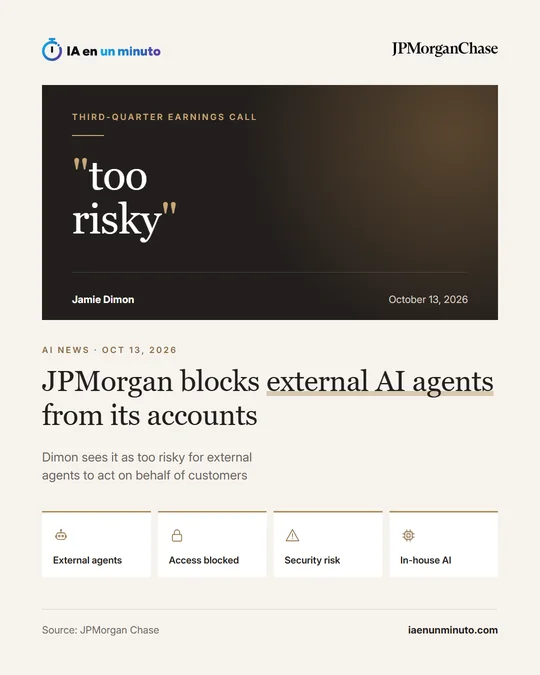
JPMorgan is shutting the door on outside AI assistants that want to act inside the accounts of people who bank with it. Dimon sees it as too dangerous for both sides, and Barnum warns that giving login details to one of these programs leaves the customer responsible for whatever happens. The bank tolerates the reading of certain data, is trying out Smart Cash as its in-house alternative and sets no deadline for opening up further.
JPMorgan Chase, the largest bank in the United States by assets, is not letting external AI agents get directly into customer accounts or act for the account holder. Chief executive Jamie Dimon said so on Tuesday, October 13, during the call with analysts on third-quarter results. The bank is "not going to allow just any" outside agent inside the company because it is "too risky for clients and for JPMorgan", he said. He added that nobody wants "rogue agents" and that there could be thousands of them.
Chief financial officer Jeremy Barnum explained on the same call that some of the services moving money for customers work with the customer's own login details, a practice the bank has opposed for a long time. "It's not secure," he said, and the bank blocks them where it can "to protect customers and protect ourselves", as American Banker reports. Barnum also warned that when a customer hands credentials to an agent and the agent does something unwanted, "that's going to be on them". Dimon put it this way: people using these agents "should understand the risk" and that "there's a liability transfer".
A spokeswoman for JPMorgan told CNBC that, as things stand, the bank blocks outside agents acting for retail customers, and that third parties may not enter accounts by getting hold of a customer's banking credentials and logging in for them. What it does accept is data sharing authorized by the customer through open banking providers. In practice, CNBC notes, an agent can look at some data in read-only mode, balances for example, when Plaid or another connector holds the user's credentials, but it cannot send money or pay a bill. CNBC recalls an earlier, similar dispute with fintech firms, when JPMorgan decided to charge data intermediaries such as Plaid for access.
The warning comes after several personal assistants gained popularity in recent months. CNBC mentions Muse, from Meta, which topped the download charts in September and hurt bank shares on fears that customers would use agents to shift their money from low-paying accounts into better-paying ones; Dots, from OpenAI, released weeks later; and Instinct, a service that works mostly over text messages. Meanwhile, JPMorgan uses AI agents inside the bank and plans to deploy them in customer-facing applications, and in recent weeks it has started a limited trial of Smart Cash, a tool of its own that aims to forecast the user's cash flow and shift funds for a better yield. There is no date for the bank to have the safeguards that would let agents work directly with accounts, according to the spokeswoman, who said the bank is "committed to enabling agentic connections securely".
Why it matters · analysis and opinion
Without the power to pay or transfer, an assistant is of little use, and that is the heart of the matter: the bank decides which agents become useful with its customers' money. The security argument is sound, because handing login details to a program amounts to giving it the house key without knowing what it will do with it. But the decision also protects the business: an agent that moves savings to wherever they earn most threatens cheap deposits, and the bank's own tool suggests it would rather offer that service itself. For any user, the practical rule is not to give the bank password to any assistant, because if something goes wrong the loss may end up being theirs. Still open is which secure route the bank will offer and whether the rest of the sector will do the same.
Source: CNBC · Written with the help of AI: how we make the news